Star Trek: Strange New Worlds – “Level-Five Transporter Accident” (S04E05) Review
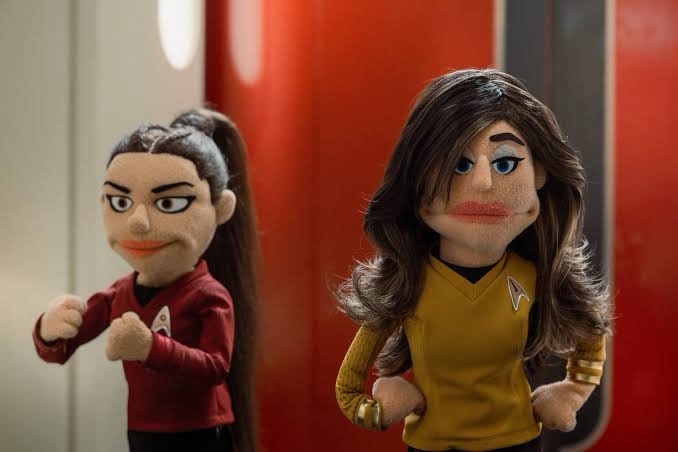
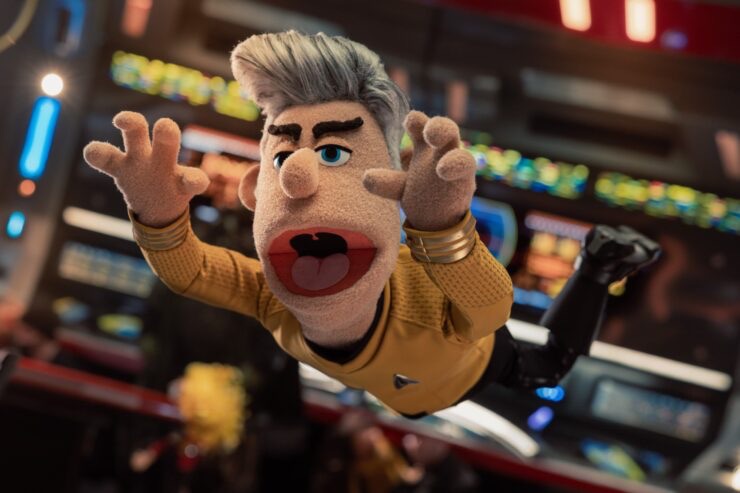
Captain Pike is floating outside the “Enterprise” without a spacesuit when “Level-Five Transporter Accident” finally clicks for me. He should be dead, but instead he looks back through the window and realises something wonderfully stupid. He is a puppet, and puppets don’t need oxygen.
That is exactly the sort of daft, lateral-thinking “Star Trek” problem solving I grew up loving. Understand the impossible thing that has happened, work out its rules, then turn those rules to your advantage. It is ridiculous, but there is something almost pure “Original Series” about it, and for a moment I thought the episode had finally won me over.
It hadn’t.
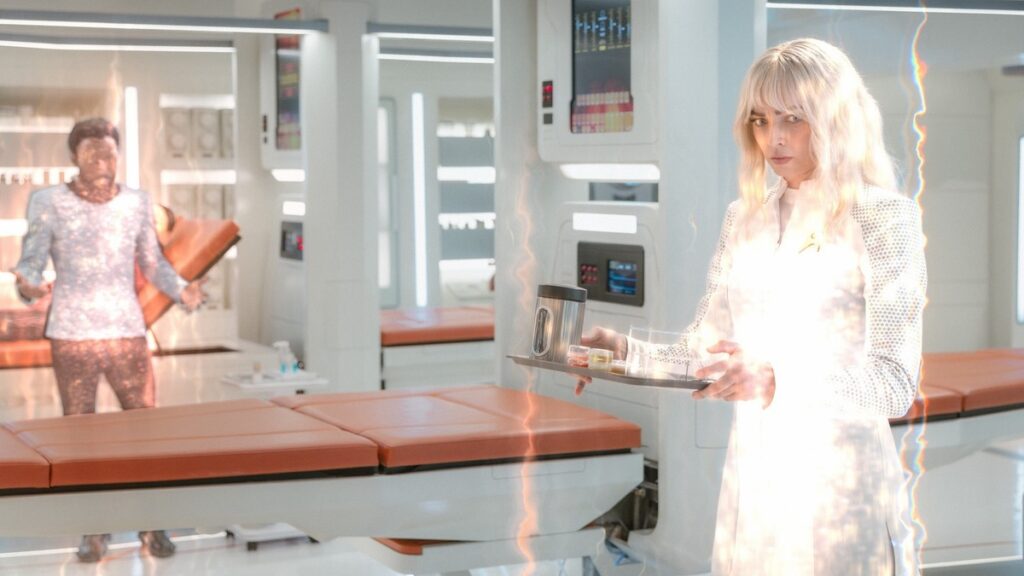
There is a difference between recognising that something has been made extremely well and actually enjoying it, and I don’t think “Strange New Worlds” has ever made that distinction quite so clear for me before. There is a brilliant cast here, some genuinely good writing, enormously accomplished puppetry, and a production team that clearly worked its backsides off making the whole thing possible.
I can see all of that. I still hated watching it.
That’s the difficulty I have with this episode, because I want “Strange New Worlds” to take risks. I don’t want “Star Trek” reduced to a list of things fans have decided it is allowed to do. The franchise has always been weird. “The Original Series” could give you deadly serious drama one week and Tribbles, gangsters, body swapping, Greek gods, or some other studio-floor fever dream the next.
“Strange New Worlds” has continued that tradition with horror, comedy, a musical, and black-and-white noir. Sometimes those experiments work for me and sometimes they don’t, but I would still rather the show occasionally annoy me than become frightened of trying anything unusual.
Apparently, however, puppets are where I discover my limit.
I don’t even object to the idea on principle. The work behind it is astonishing. The Jim Henson Company created puppets recognisable as these specific characters, fourteen puppeteers were involved in bringing the crew to life, and the production had to alter parts of the “Enterprise” sets to make the whole thing physically possible. Pike’s new captain’s chair was even rebuilt so a puppeteer could operate through it.
I genuinely admire that, partly because I spent years lettering comics and it taught me to appreciate the slightly invisible bit of creative work between having a clever idea and actually making the thing work. Ideas are easy. Execution is where somebody ends up spending hours solving problems nobody watching at home will ever know existed.
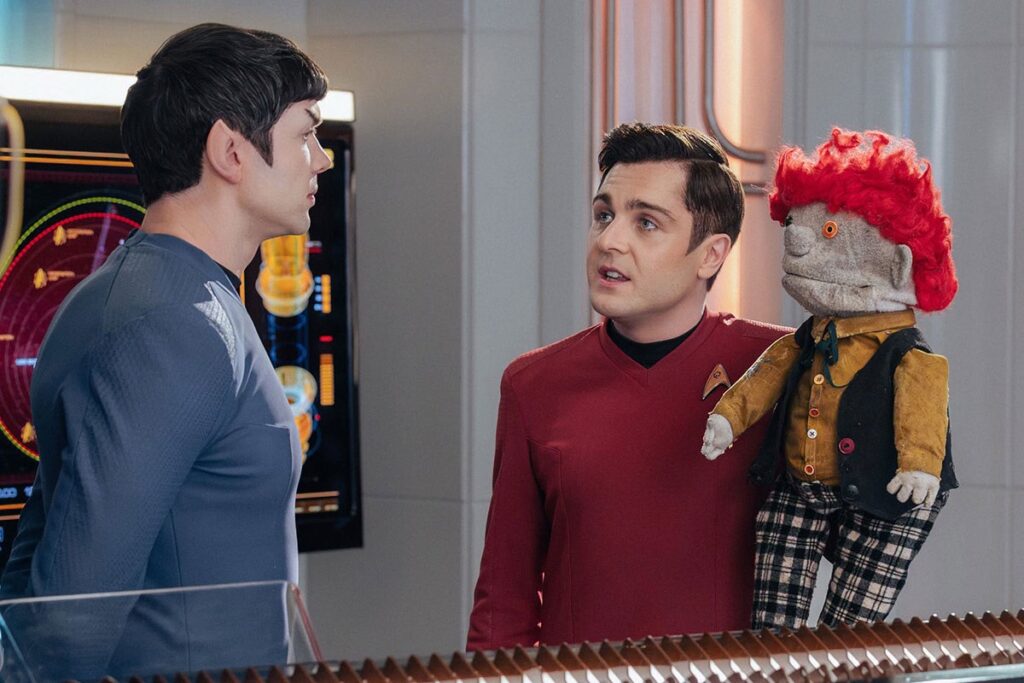
Someone had to figure out how these puppets moved around sets designed for human actors, how fights and blocking would work, where the puppeteers could physically fit, how the cameras could capture them, and how all of it could still look like the “Enterprise” rather than a particularly expensive sketch show. This isn’t a gimmick somebody knocked together because puppets sounded funny in a writers’ room. They committed to it completely.
Unfortunately, I still found it horrible to watch.
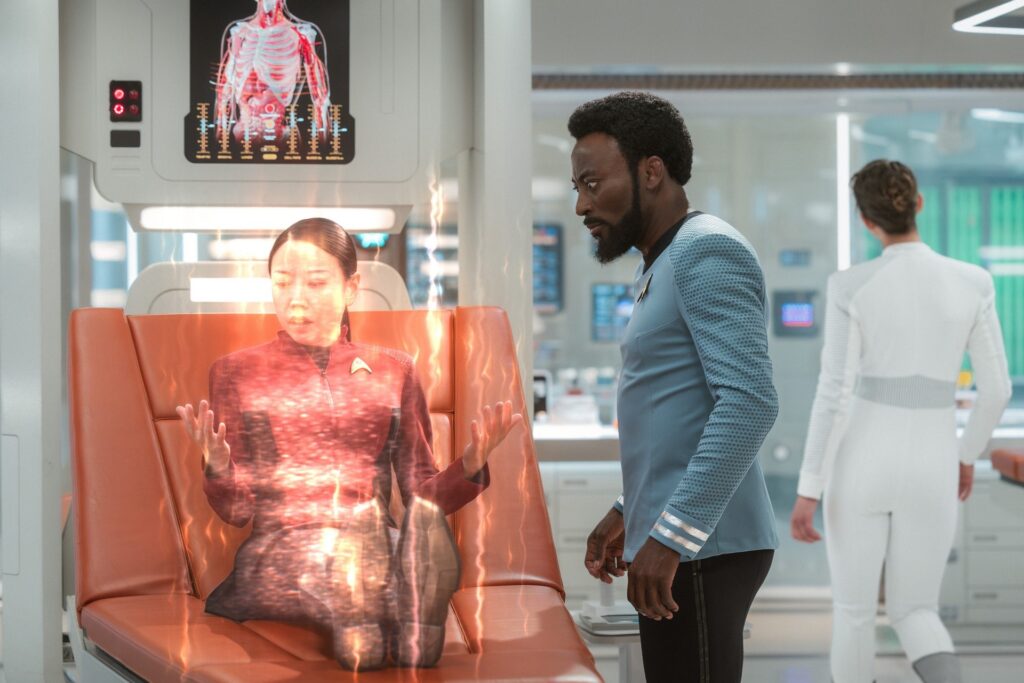
Scotty’s attempt to extend transporter range goes catastrophically wrong and almost everyone aboard the “Enterprise” ends up transformed into a puppet. Spock, who was away from the ship at the time, remains reassuringly flesh coloured and equipped with functioning fingers, which suddenly makes him the most important man aboard.
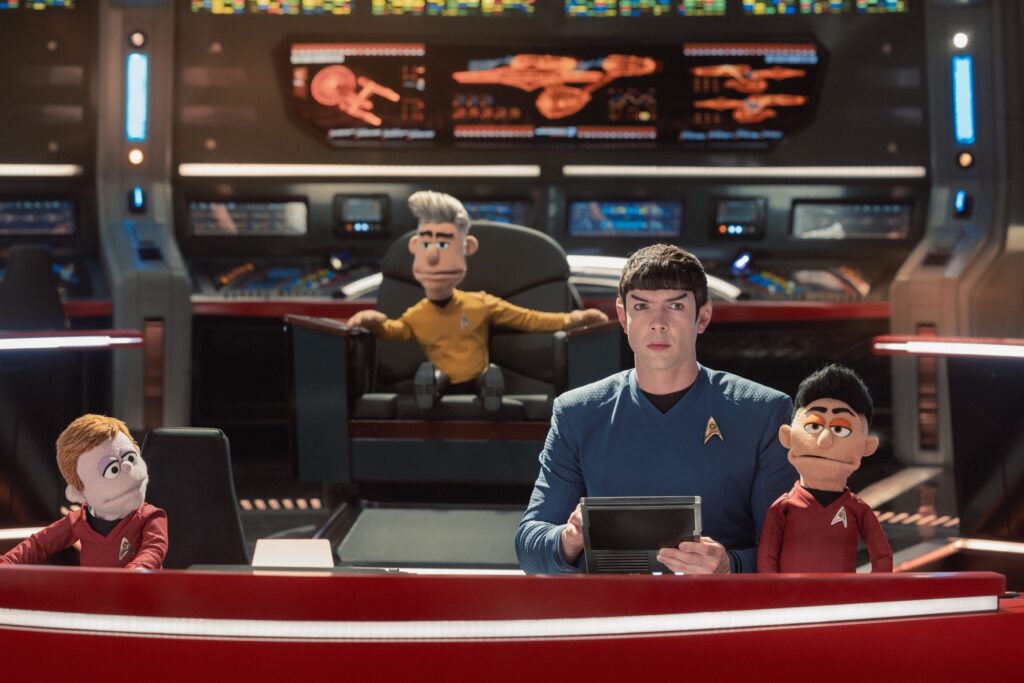
The puppets can’t operate most of the controls, so every problem eventually becomes Spock’s problem, and that gives Ethan Peck some of the best material in the episode. Spock isn’t exactly starting from a healthy place either. What happened aboard the “Griffin” has left him questioning his own mind, La’an ends whatever their relationship has become just before everything goes wrong, and his instinct to crawl back towards Vulcan logic brings T’Pring into his life again along with a fairly substantial amount of unresolved resentment.
Then everyone starts shouting for him. Someone needs a door opened, Engineering needs him, Uhura needs him, Pike needs him, and somewhere aboard the ship somebody has undoubtedly misplaced something else requiring opposable thumbs.
Everybody assumes Spock will cope because Spock always copes, right up until he doesn’t.
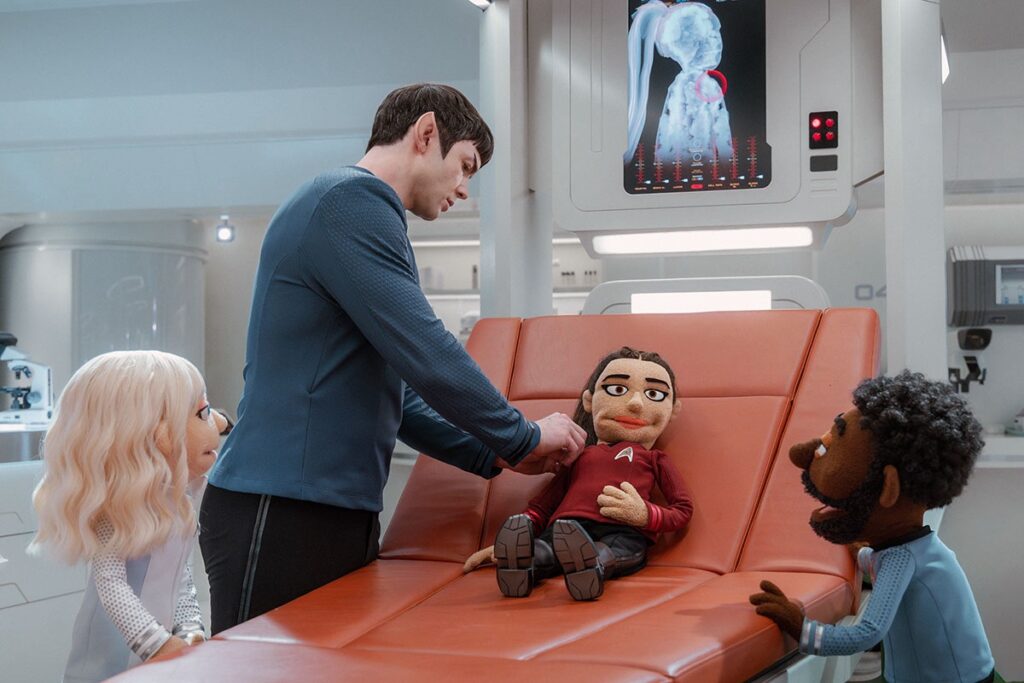
His anxiety attack works because it turns one of Spock’s greatest strengths against him. Being the person everyone relies upon carries its own pressure, especially when nobody stops to wonder what happens when that person has finally had enough. Spock running between stations begins as a joke, but gradually the joke disappears and what is left is someone genuinely overwhelmed by being indispensable.
There is some very good character writing buried underneath all the felt, and La’an gets the scene that should probably have affected me most.
When Scotty tries to restore her and fails, she is strangely happy to discover that she is still a puppet. Her arm then falls off, because apparently that is now the sort of sentence I get to write in a “Star Trek” review.
Spock sews her back together and asks why she seemed so relieved, and her answer is much darker than anything surrounding it. La’an is frightened by what is happening to her and by the Augment heritage she carries. If she is made of felt and stuffing rather than flesh and blood, she reasons, then she can’t become the monster she fears might already be inside her.
That’s a proper gut-punch of an idea, and it is also where my problem with the episode became impossible to ignore on a second watch. I can see exactly what the scene is trying to do. I think the writing works, I care about La’an, and I understand the fear driving her.
But I am looking at a puppet, and instead of the absurdity making the emotion hit harder, the puppet keeps putting a layer between me and the character.
That happens again and again. The vocal performances and the physical performances don’t always feel completely joined together either. That’s hardly surprising considering what everyone involved is trying to achieve, and the cast and puppeteers clearly put serious work into getting it right, but it became something I kept noticing. Once I noticed it, I couldn’t stop noticing it.
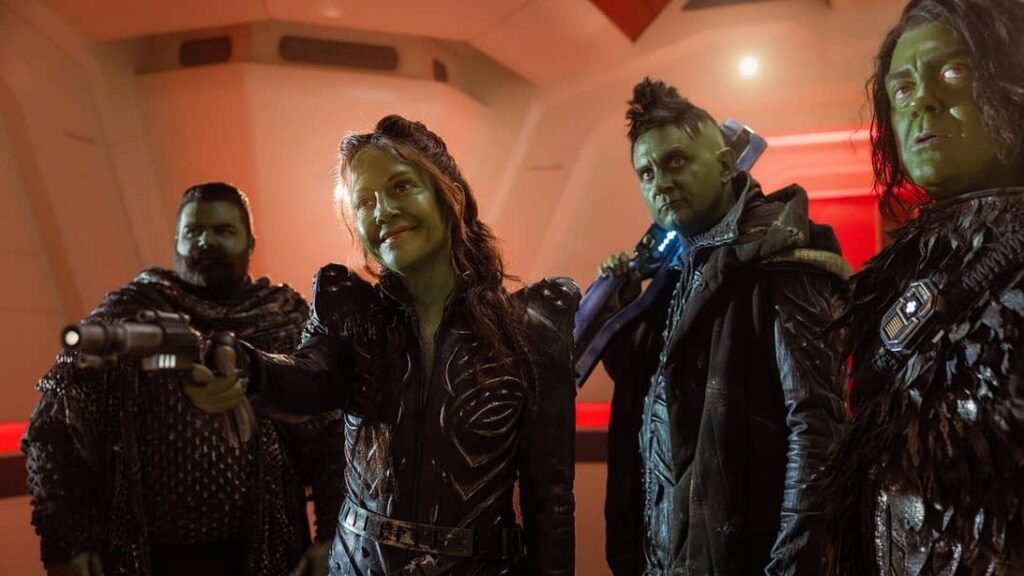
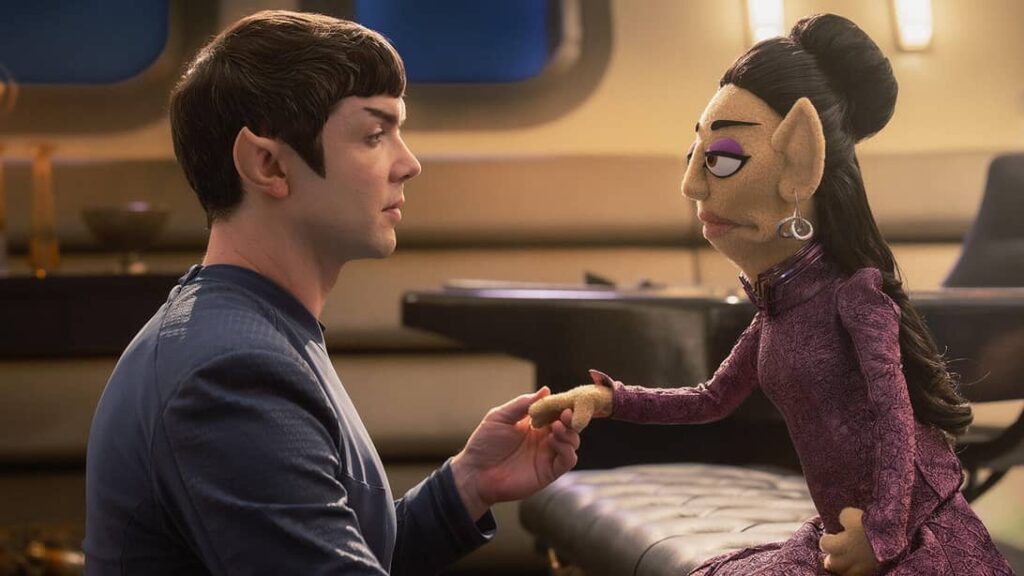
There is also a point where the sheer stupidity of what I am watching stops being charming and just becomes stupid. Spock kissing puppet T’Pring is one of those moments. The crew trying to physically fight the Orion pirates is another. I know that is supposed to be the joke, and I know the episode is deliberately pushing everything towards Muppet-style absurdity, but knowing why something is ridiculous doesn’t automatically make it funny.
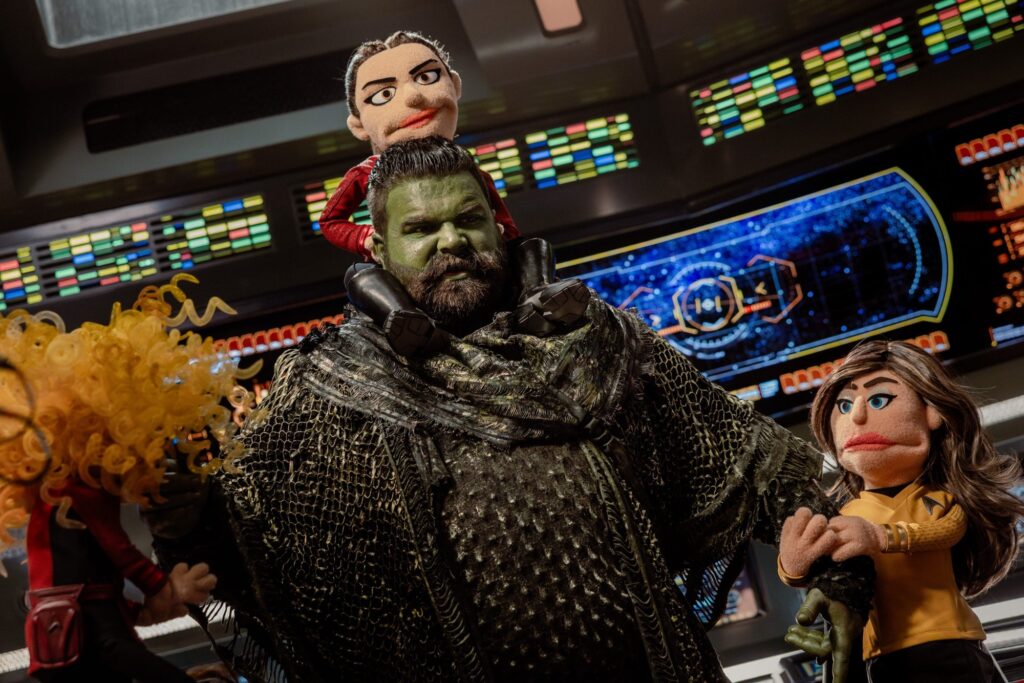
Watching Una and La’an ineffectually punch full-sized Orions, Ortegas flailing away, or T’Pring leaning in for a romantic kiss while made of felt didn’t make me embrace the madness. It made me wonder how much further the episode could push the gag before I completely stopped caring about what was happening. There is a line between “Star Trek” being knowingly silly and the characters becoming props in somebody else’s comedy sketch, and for me this episode crosses it several times.
That is probably why the better character material struggles so much. One minute I am being asked to take Spock’s anxiety or La’an’s fear seriously, and the next I am watching puppets slap pirates around or make out. That tonal contrast can work, and “Star Trek” has made it work before, but here it mostly left me bouncing in and out of the episode rather than being carried along by it.
There are moments where the puppetry itself becomes funny enough to break through that problem. Carol Kane is probably best equipped for this sort of nonsense. Pelia being sliced in half and responding with roughly the same level of irritation she would normally reserve for a badly organised engineering shift is wonderful, and the Pelia puppet itself looks fantastic, all curly yellow hair and complete Lanthanite indifference to the fact that she currently exists in two separate pieces.

The episode also gets much better whenever it stops treating puppet bodies as the joke and starts treating them as the science-fiction problem. La’an’s arm can be sewn back on, Pelia can survive being chopped in half, Pike doesn’t need oxygen, and traditional hand-to-hand combat is useless because the crew can survive things their Orion attackers can’t.
Eventually Pike understands what the episode should have been doing all along. Stop trying to behave like humans who have unfortunately become puppets and start fighting like puppets.
That’s the good stuff. The absurd premise develops rules, and the characters use those rules to solve the problem, which suddenly makes the whole thing feel much more like “Star Trek” again.
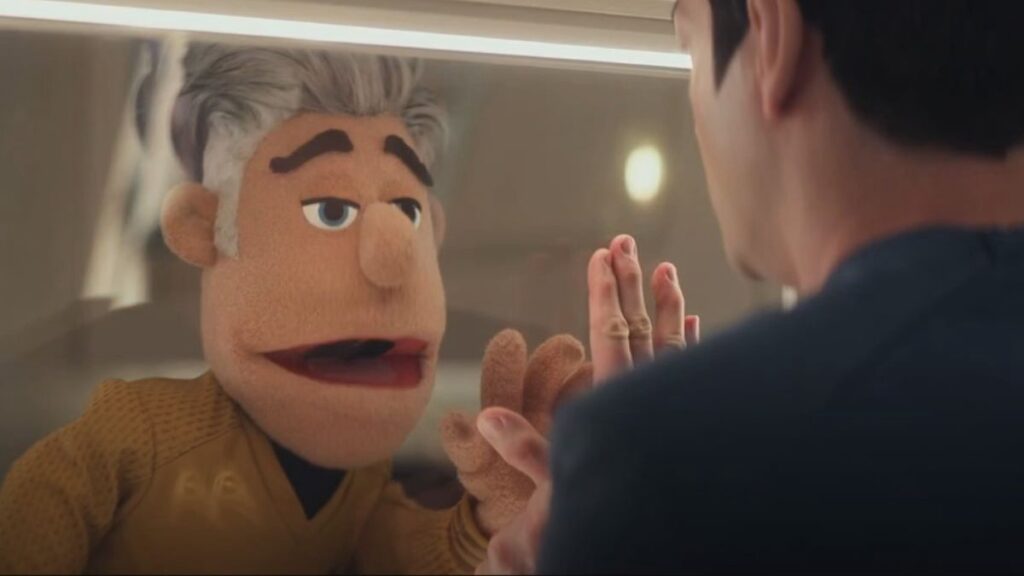
Even the shameless “Wrath of Khan” gag works for me. Pike is trapped in the airlock with Spock on the other side of the glass, they press their hands towards one another, and Pike begins the familiar “needs of the many” line before being rather unceremoniously fired into space. It’s cheeky, it knows it’s cheeky, and I laughed.
If “Level-Five Transporter Accident” had carried on from there, with the crew reclaiming the ship, turning themselves back into humans, and carrying on with their lives, I still wouldn’t have liked the episode very much. That’s worth saying plainly because this isn’t an episode ruined entirely by its ending.
The puppet concept itself is simply a step too far for me. I can appreciate what everyone involved has achieved, and I can defend “Strange New Worlds” having the right to make something this ridiculous without pretending I enjoyed sitting through it.
But I could have respected the commitment.
Then Spock wakes up.
OH COME ON!!!
The entire puppet adventure was a dream.
There really was an accident involving Scotty’s transporter experiment, but Spock was the one affected. Everything else came from his unconscious mind while he lay there recovering. The puppet “Enterprise”, the Orion takeover, Pike getting blown into space, T’Pring embracing chaos, La’an’s confession, all of it existed only inside Spock’s head.
I HATE this ending, not because dreams cannot tell us anything about a character, because obviously this one does. Spock’s subconscious is practically waving semaphore flags about stress, emotional confusion, his relationship with La’an, his unresolved feelings towards T’Pring, and the pandemonium he associates with life aboard the “Enterprise”.
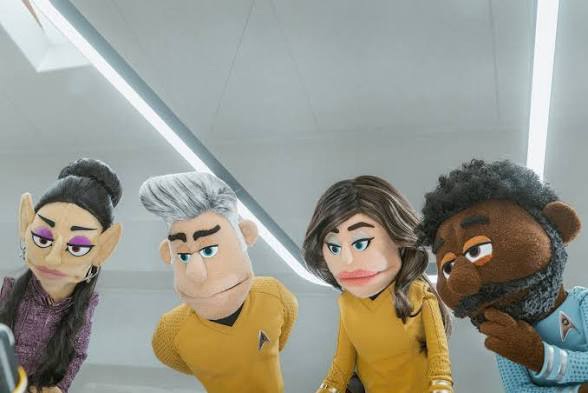
Fine. The problem is what happens to everyone else.
La’an never told Spock that being a puppet made her feel safe from becoming a monster. Spock dreamed that she did. T’Pring never experienced something completely irrational, discovered that Spock’s collection of weirdos might actually be good people, and found some small value in embracing chaos. Spock dreamed that too.
Scotty never gets to prove himself under pressure. Pelia never gets that moment with him. Pike never really discovers a new way of looking at their condition. Those aren’t shared experiences between characters any more. They are Spock’s projections of them.
That bothers me far more than a normal television reset button. “Star Trek” has been resetting itself at the end of episodes for sixty years. The ship gets repaired, everyone goes back to their stations, and apparently nobody requires six months of counselling after whatever nightmare happened on Tuesday.
Fine. But the events still happened.
“Subspace Rhapsody” understood that. Whatever anyone thinks of the musical episode, “Strange New Worlds” went for it. Those characters really sang, they really exposed things they would rather have kept hidden, other people heard them, and they had to live with the embarrassment afterwards. Nobody woke up and discovered the singing Klingons were the result of a dodgy cheese sandwich.
“Level-Five Transporter Accident” spends most of its running time asking me to accept that everyone aboard the “Enterprise” has genuinely become a puppet, then backs away from its own idea at the last possible moment.
That is especially frustrating because the episode has already told us what its own solution should be. Pike stops resisting what has happened, T’Pring accepts that logic isn’t going to explain every ridiculous thing around her, and Spock has to stop trying to control everything.
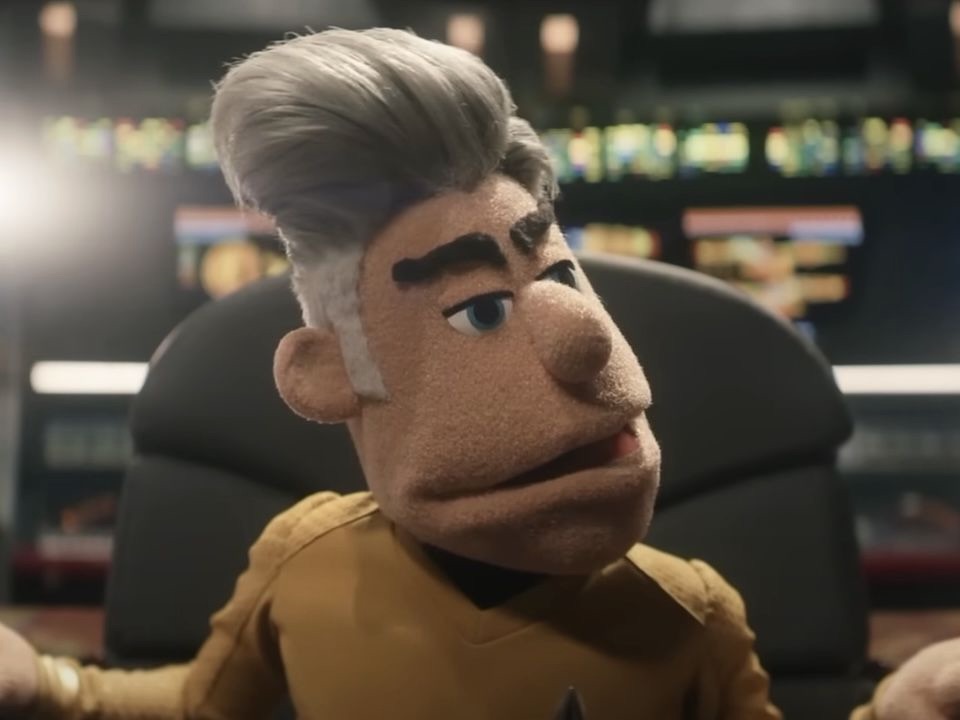
They embrace the chaos.
The episode doesn’t.
That’s the bit that really gets me. I spent most of “Level-Five Transporter Accident” thinking that I really didn’t like this, but fair play to them for actually doing it. Then the ending tells me they didn’t really do it at all.
What a waste.
There is an enormous amount of talent in this episode. Ethan Peck gets some excellent material, Christina Chong gets a genuinely painful character moment, Carol Kane remains an absolute gift, and the puppeteers, designers, crew, and everyone involved in making this technically possible deserve enormous credit.
I can admire all of that without pretending it adds up to an episode I enjoyed. In fact, that’s probably the strangest thing about “Level-Five Transporter Accident”.
It is a really well-made episode of television that I never want to watch again.
4/10