
Star Trek: Strange New Worlds — “Like Chronitons Through the Hourglass” (S04E07) Review
There is a point late in “Like Chronitons Through the Hourglass” when Christopher Pike sits with the Enterprise’s counsellor and finally says five simple words: “I taught her to read.”
That was the point where this episode finally got me.
Pike is talking about Juliet, the daughter he and Marie Batel had during the impossible lifetime they experienced in “New Life and New Civilizations”. He remembers her green eyes, the little freckle beside her nose, teaching her to read, watching her grow up, and eventually walking her down the aisle. None of that happened in the reality Pike has returned to, but the memories are his and, emotionally, Juliet was his daughter. When Dr Chivers asks him to acknowledge what he has actually lost, Anson Mount lets all of that weight settle on Pike without turning it into a grand performance.

It is genuinely moving, and probably some of the strongest Pike material we have had this season.
Unfortunately, I had spent most of the episode waiting for Strange New Worlds to stop taking the piss long enough to get there.
Written by Dana Horgan and Bill Wolkoff, and directed by Anna Dokoza, “Like Chronitons Through the Hourglass” traps the Enterprise crew inside a daytime soap opera created by Trelane, with Rhys Darby returning as the reality-bending nuisance from “Wedding Bell Blues”. The title itself riffs on Days of Our Lives, and the casting goes one step further by bringing genuine soap royalty Deidre Hall aboard as Enterprise counsellor Dr Eleanor Chivers.

On paper, I can see the idea.
In practice, the whole thing is cheesy as hell.
Pike wakes after a supposed shuttle accident to find everything brighter, softer, and more melodramatic than it should be. People stare into the middle distance. Music appears from nowhere. Conversations are full of absurd pauses and enormous revelations, while the camera pushes into faces as though somebody has just discovered their evil twin has secretly married their long-lost sister.
The problem is not that any of this is inaccurate. Quite the opposite. The production team clearly knows exactly what it is parodying.
The problem is that I did not find much of it funny.

Pike is almost immediately aware that something is wrong and starts commenting on the same things we are supposed to be laughing at. He notices the melodrama, questions the dramatic pauses, wonders whether they are back inside a musical reality, and eventually realises that the “fancy coat god guy” has returned. Instead of letting the ridiculous situation play out and trusting us to understand the joke, the episode keeps explaining the joke while we are watching it.
That self-awareness has started to grate on me enormously.
I am not against Star Trek being funny, nor do I want Strange New Worlds to become forty-five minutes of people discussing Federation policy around a conference table every week. Trek has always moved between tones, experimented with form, and occasionally become gloriously ridiculous. The problem is not the swing. It is whether there is enough underneath it to justify taking the swing in the first place.
Season 4 increasingly feels as though the show is trying on genres like outfits in a changing room. Horror, noir, puppets, now daytime soap opera. Sometimes that experimentation gives the characters another way to tell their story, and “Off-Hour” showed how well a stylistic choice can work when the form actually tightens everything around it.
Here, the gimmick becomes the story for far too long.
I genuinely found myself longing for a normal episode of Star Trek.

The Uhura material probably sums up my problem better than anything else. Inside Trelane’s soap reality, she discovers that Pike is apparently her biological father and that the parents we know she lost were secretly her adoptive parents. Pike quite rightly points out that he has read her file and knows this is nonsense, but that is irrelevant because soap-opera logic has taken over.
Yes, it is supposed to be ridiculous. That does not automatically make it entertaining.
We spend all this time on a knowingly ludicrous secret-daughter story, complete with an orphanage, mysterious recipe book, abandonment issues, and Pike being expected to accept a daughter he knows he does not have. Then the episode eventually pivots back towards Juliet, the daughter who actually matters to Pike emotionally, and suddenly there is something real sitting underneath all the noise.
I understand what the Uhura story is doing structurally. Trelane is forcing Pike into the role of a father because there is something about fatherhood and loss he has refused to confront.

I just wish getting there had not been such a slog.
Trelane himself works slightly better for me, largely because Rhys Darby knows precisely how annoying this character should be. We already know from his previous appearance that this is Trelane, even though Pike hilariously cuts him off before he can finish introducing himself, and there is something appropriate about him discovering soap operas and deciding humanity should be shoved into one as part of his latest experiment.
His Proctor is even dressed in robes deliberately evocative of Q’s judge costume from “Encounter at Farpoint”, another rather unsubtle reminder of where all this is eventually heading.
I like the reference. I like the visual.
I am less convinced that Trelane himself adds much beyond providing the mechanism through which the episode can happen. The emotional resolution belongs to Pike, Chivers, and the memories Trelane accidentally drags back to the surface. Trelane mostly watches his experiment unfold from his television control room, delighted whenever his characters produce unexpected drama.

Again, I understand the joke.
By this point, I was rather tired of being told there was a joke.
Artistically, though, I cannot really fault the commitment.
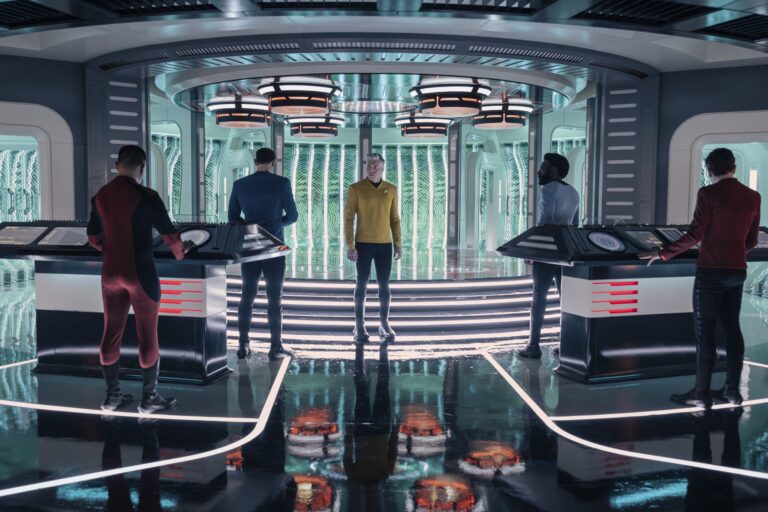
The Enterprise looks deliberately horrible during the soap sections, and I mean that as a compliment. Everything is overlit and slightly soft, faces are framed too closely, the colours have that artificial daytime-TV sheen, and the performances are pushed just far enough beyond normality to make the whole ship feel wrong.
There is real craft involved in making something look deliberately cheaper than one of television’s most expensive science-fiction programmes.
The hair and costume work understands the assignment as well. Having spent years around hair and fashion, I can appreciate the amount of work involved in recreating an aesthetic that is supposed to feel heightened and artificial without simply looking incompetent. The visual language is specific enough that you understand what has happened before anybody needs to explain it.

Which makes it slightly frustrating that the dialogue keeps explaining it anyway.
The best visual choice comes when the soap-opera scaffolding finally begins to disappear and the episode quietens down. The lighting becomes moodier, the framing relaxes, and suddenly Anson Mount has space around him again. The production stops shouting about what kind of television programme we are watching and lets Pike sit in a room with another person.
That is when the episode becomes good.
Pike’s grief over Batel has been sitting underneath Season 4 from the beginning, but “Like Chronitons Through the Hourglass” finally gets specific about what he actually lost. Marie is gone from his life, transformed into the Beholder and condemned to remain apart from him, but Pike is not simply grieving the woman he loved. He is grieving everything that was supposed to come afterwards.

He knows what that future looked like because, impossibly, he remembers living it.
He and Marie had Juliet. They raised her. Pike watched her grow into an adult and saw her fall in love. He remembers being her father with the same emotional certainty that he remembers commanding the Enterprise.
Then he came back.
That is a fantastic Star Trek idea.
There is an obvious echo of “The Inner Light” in somebody carrying the memories of an entire life that nobody around them experienced, although I would not push the comparison much further than that. What matters here is the same uncomfortable question: if the experience was real to you, does everybody else knowing it never happened actually make the loss hurt less?
Of course it does not.

Mount is superb in those final scenes because he keeps Pike small. There is no giant breakdown and no speech designed for an awards clip. He looks tired. His voice begins to thin. Then he talks about teaching Juliet to read, and suddenly this strange hypothetical child becomes painfully specific.
That is the episode I wanted.
Ethan Peck also gets some genuinely interesting material as the soap reality’s version of Sybok. It is not the real Sybok, something the episode makes clear once reality returns, but Peck gives him enough menace and bitterness that I immediately wanted to see more. He lets the intensity sit just beneath the performance instead of turning Sybok into another part of the camp, and it is a shame that such an intriguing version of the character only exists inside Trelane’s ridiculous experiment.

The M’Benga and Ortegas material works for much the same reason. Their supposed “space madness” is another stupid soap diagnosis, but underneath it are two people talking about anxiety, vulnerability, and the fear that admitting they are struggling could cost them the jobs that define them. Once again, there is a real character idea hiding underneath the parody.
The final La’an and Spock scene may be my favourite quiet moment in the episode.
La’an has just spent time with a version of Spock’s family and emotions filtered through this distorted reality, only to find herself standing opposite the actual Spock again. She tells him she does not regret their breakup but had not realised how much she was going to miss him. Spock responds exactly as Spock would, and there is no dramatic reconciliation waiting around the corner.
They just say goodbye.
It feels unfinished in exactly the right way.
Those are the moments that remind me why I fell for Strange New Worlds in the first place. Mount, Peck, Chong, Navia, and Olusanmokun do not need another clever format wrapped around them to make these characters interesting. Give them something human to wrestle with and let them do the work.

Which brings me back to why I dislike this episode as much as I do.
There is a genuinely good Star Trek story here.
It is just buried underneath far too much television about television.
Even the absence of Scotty annoyed me. Martin Quinn is now part of the main Season 4 cast, yet there is no Scotty here at all, and Pelia is absent too. It might sound like a tiny complaint beside everything else, but in an episode supposedly enjoying the opportunity to throw the Enterprise ensemble into ludicrous alternate character dynamics, leaving both of its engineering personalities out feels like a wasted opportunity.
More broadly, “Like Chronitons Through the Hourglass” is where my patience with this season’s constant tonal swerves has finally started running out.
I gave “Level-Five Transporter Accident” 4/10. I disliked the puppets, thought the episode pushed the silliness too far, and came away disappointed that such a good cast had been given something I found so difficult to enjoy.
I cannot believe I am saying this, but I think the puppet episode is better than this.

This has better individual scenes. In fact, the final stretch contains some considerably better material than anything in Episode 5. But a strong ten minutes does not erase how little I enjoyed most of the preceding episode, and in some ways those final scenes make the failure more frustrating because they prove what was sitting there all along.
Pike grieving the future he lost with Marie is enough.
Pike grieving Juliet is enough.
La’an trying to say goodbye to Spock is enough.
M’Benga and Ortegas admitting that sometimes the people expected to hold everyone else together are struggling themselves is enough.
The episode does not need thirty-odd minutes of dramatic pauses and soap-opera winking to make any of those things matter.

“Like Chronitons Through the Hourglass” ends up in “Spock’s Brain”, “Retrospect”, and “Sub Rosa” territory for me. Not because there is nothing worthwhile inside it — there absolutely is — but because the good material has to fight its own episode for attention.
For a few minutes near the end, Strange New Worlds stops showing me what kind of television programme it can impersonate and simply lets Christopher Pike mourn his daughter.
Those few minutes are excellent.
I wish the rest of the episode had trusted them.
3/10