
Star Trek: The Last Starship, Vol. 1 Review — A Future Paid For in Lost Time
Carter House is still standing, but almost everything else has changed.
Before going any further, huge thanks to IDW for the review copy.

When Wowie Carter first returns home in 3070, Earth is still wounded by the Burn, but there is warmth waiting for him. His parents rush to embrace the son they have barely seen, while Wowie looks almost exactly as he did when he left. Five years later, he comes home again to find them visibly older and Carter House transformed into part of an increasingly guarded Earth. By 3088, his father is dead, his mother has lived another thirteen years, and the warmth of those earlier visits has been replaced by rain, darkness, and a grave beneath the trees. For Wowie, those thirteen years have lasted just three months.
That is the image that stayed with me after finishing Star Trek: The Last Starship, Vol. 1. Not James T. Kirk returning from the dead, the Federation collapsing, or Klingon ships burning the Earth beneath them, but one young Starfleet officer slowly losing his family to time while he remains almost untouched by it. This book contains enough enormous ideas to power several different series, yet it is in these quiet visits to Carter House that those ideas finally become human.
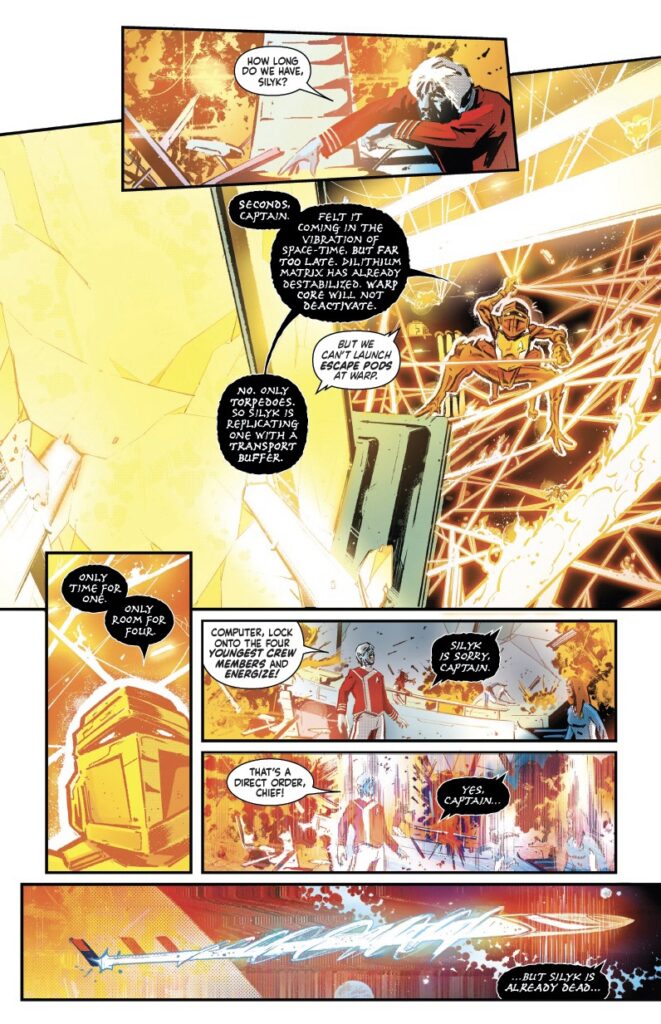
Collin Kelly and Jackson Lanzing have built a genuinely fascinating premise from some of modern Star Trek’s least-developed pieces. They take the Burn, which Discovery introduced as a century-old catastrophe and explored largely through its aftermath, and put us right there as it happens. Active dilithium destabilises across the galaxy in roughly five minutes, warp cores erupt, 96 per cent of Starfleet is lost, and the death toll climbs into the trillions. The seemingly permanent network of ships, worlds, and institutions holding the Federation together is suddenly replaced by distance, silence, and fear.
The opening handles that collapse brilliantly. Starfleet’s surviving captains gather and discover that the people in the room are almost the entire captaincy left alive. The Federation is predicted to dissolve within a year, something Captain Delacourt Sato simply refuses to accept. His answer is wonderfully Starfleet: build another ship. Not because one vessel can realistically replace an entire fleet, but because perhaps seeing the Federation flag moving between the stars again will remind people that something still exists behind it.

There is, of course, one fairly substantial problem. Without reliable dilithium, how does the thing actually move?
The answer is Agnes Jurati and her Borg Cooperative. They can provide the dilithium-free transwarp technology needed to power the newly assembled USS Omega, but Jurati wants access to a specimen stored on the abandoned Daystrom Station. From that biological material and its last recorded neural pathways, the Borg reconstruct James T. Kirk, dragging him from his death on Veridian III into a future where almost everything he knew has disappeared.
On paper, bringing Kirk back should be exactly the sort of thing that sets me on edge. I am generally wary of resurrecting beloved characters after their stories have already ended, especially when death itself provided that ending. Too often, it feels less like storytelling than somebody rummaging through the franchise cupboard because a familiar face is easier to sell than trusting the new characters to carry the story.
Kirk works better here than I expected because the book understands that resurrection is not restoration. He does not simply wake up, find a bridge, and start being Captain Kirk again. He questions whether the memories inside him are really his, whether David was truly his son, and whether the body carrying those memories is anything more than a Borg-built imitation of a dead man. Starfleet has brought back one of its greatest symbols at the precise moment it needs symbols most, but there is an uncomfortable second purpose lurking underneath that decision. Kirk is also something they can point at an enemy.
That becomes impossible to ignore when the Klingons arrive.

Sato has studied Kirk extensively and reduced him to what he considers the uncomfortable truth beneath the legend: a man of war whose command left thousands dead. He keeps Kirk away from the crew because he fears what putting that man on the bridge might unleash. Then Earth comes under attack from a nihilistic Klingon fleet, and suddenly it is exactly that side of Kirk that Sato needs.
Kirk uses his knowledge of Klingon tradition to push Sato towards challenging Ha’Shet, taking command of her fleet under Klingon law, and stopping the bombardment of Earth. It works, but what makes the whole thing difficult for me is that Kelly and Lanzing clearly know the Kirk they are resurrecting had already grown beyond this.
The book explicitly remembers David’s murder and the years of hatred that followed. Kirk himself recalls that it took him a decade to get beyond that hatred, while the narration recognises the older man who eventually made peace with the warrior beneath his skin. This is not the writers accidentally forgetting The Undiscovered Country. They know exactly where Kirk ended up and deliberately drag that old rage back to the surface because this broken future needs a weapon.
That is much more interesting than simply getting Kirk wrong, but I am still not convinced the story completely earns it. Kirk’s isolation and uncertainty give the regression a psychological foundation, and by the end he admits that his friends, his life, his ship, and his purpose are gone, leaving rage as the only part of himself he still recognises. I understand what Kelly and Lanzing are doing. I am just less convinced that acknowledging the regression is the same thing as earning it.

Kirk already went through the loss, hatred, and painful self-examination that allowed him to move beyond this version of himself. If you are going to dig that violence back out, especially after physically resurrecting the man to do it, I think it needs more than simply showing us that this new Kirk feels lost.
The post-Burn mechanics produce a similar problem, although not quite the outright continuity hole I initially thought they were heading towards. Starfleet tells us that dilithium is inert and that even activating another warp core risks another Burn. Shortly afterwards, the Omega detects Klingon ships arriving under warp.
That sounds completely contradictory, but the later pages do supply an answer. The Klingons are using unstable warp fields, knowingly risking their dilithium, and eventually turning warp cores into weapons. When twenty-nine Klingon worlds later erupt in dilithium detonations, it becomes obvious that these ships were never travelling around as though the Burn had not happened.
So the rules are not necessarily broken. They are just explained badly enough to look broken.
“Dilithium is inert” sounds absolute, while what follows suggests something much messier: dilithium can still potentially be forced into use, but doing so is extraordinarily dangerous and unstable. Those ideas can coexist, but a story building its entire political and technological landscape around the loss of safe warp travel really needs to communicate that distinction more clearly. The reader should not have to stop and repair the mechanics themselves while the story is moving.

Sato gives me a different sort of problem. His first confrontation with Kirk reduces decades of command to a body count before Sato proudly announces that he has no deaths on his own conscience. It is an astonishingly self-righteous way to judge another captain, particularly from someone whose own decisions are about to place people in situations involving violence, death, and impossible choices.
The book does eventually turn that certainty back on him. Solara K’Sarsik accuses Sato of holding Federation ideals so tightly that he leaves no space for anything else, remaining rigid while training everyone around him to be flexible. That matters because it shows the story knows Sato’s certainty is a flaw rather than treating him as its unquestioned moral authority.
Even so, the original argument with Kirk still bothers me. Kirk has to answer for every death that can be traced back to his command, while Sato gets to present an untouched conscience as evidence of moral superiority. Perhaps the imbalance is intentional, but it still makes me slightly agitated.
The wider Omega crew is where the book starts to struggle more seriously. Jurati, Sato, Kirk, and especially Wowie have clear internal conflicts, but several people around them remain closer to functions, attitudes, or distinctive silhouettes than people I became particularly invested in. That is a problem for any ensemble, but it becomes a much bigger one when the whole premise is built around the last fragments of Starfleet trying to hold civilisation together.
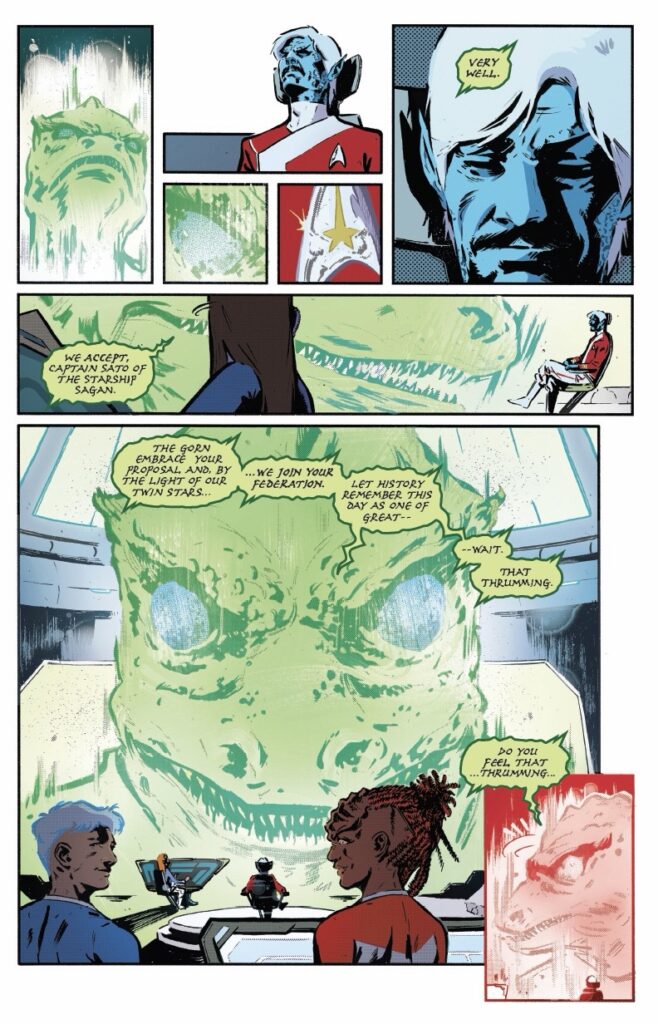
There are deaths where my reaction was closer to trying to remember who had just died than feeling the impact the page clearly wanted from me. In a story about who is left standing after almost everyone else is gone, I need to care much more about the people still standing.
Wowie is the exception, and perhaps that is why his story hits so much harder. He does not need pages of biography because every return to Carter House shows us exactly what serving aboard the Omega is costing him. The ship’s Borg-derived transwarp drive does not work like the conventional warp bubble Starfleet is used to. Instead, the Omega approaches light speed through rather more brute-force methods, leaving its crew subject to relativistic time dilation. A mission lasting four months for them takes twenty-three years for everyone else.
It is a cracking piece of Star Trek science because the physics only matters insofar as it hurts somebody.
The Omega’s crew can cross the remnants of the Federation and help hold its scattered worlds together, but they cannot remain part of the lives they are supposedly protecting. Every journey forward carries them further away from everyone waiting behind. Wowie is not making one glorious sacrifice for Starfleet; he is watching his place in his own family disappear a few years at a time.
Adrián Bonilla’s artwork makes that loss tangible. His rough, heavily inked pages are a long way from the polished cleanliness that can creep into Star Trek comics, and this story is better for it. Ships, cities, uniforms, and faces look like they have survived something rather than simply being placed against a darker background. There is dirt in this future, and exhaustion, and a sense that the Federation’s polished edges have gone with everything else.

The Carter House pages are where Bonilla’s visual storytelling works best for me. The composition repeats while the world around Wowie changes, allowing us to watch years accumulate around somebody who barely ages. Heather Moore colours issues one through three, with Lee Loughridge taking over for issues four through six, and the later Carter material falls into Loughridge’s half of the book. By Wowie’s 3088 visit, the colour and atmosphere have collapsed into cold rain, darkness, and the grave of the father who was alive only three subjective months earlier.
That does more world-building than another page of political dialogue ever could.
The political side of the story is ambitious in its own right. Earth withdraws from the Federation, the long-planned Babel Conference becomes an attempt to decide what remains, and Solara helps turn the crisis into the foundation of the Emerald Chain. The Federation does not disappear because somebody blows up a headquarters or lowers a flag. It fails because its worlds can no longer rely on it to reach them, protect them, or provide the basic infrastructure that once made membership mean something.
Into that vacuum comes an alliance offering something much more immediate: dilithium, trade, mutual defence, and the promise that individual worlds will control their own future.

That is smart connective tissue with Discovery, just as Jurati’s presence carries forward one of Picard’s more awkwardly abandoned ideas. Kelly and Lanzing are effectively doing narrative triage here, gathering loose pieces of modern Star Trek continuity and trying to turn them into a coherent stretch of history rather than a collection of things earlier stories introduced and then moved away from.
A surprising amount of it works. The problem is that the strain starts to show whenever the book has to move from the big idea to the people living inside it. Political conversations become dense, some character development is hurried, and there are moments where the dialogue feels as though it was written for actors delivering speeches in close-up rather than for the economy of a comics page.
The ending brings almost all of those strengths and weaknesses together. Kirk infiltrates the Emerald Chain flagship and prepares to deliberately create another Burn, destroying the ship, its leadership, and himself in the process. He describes himself as a monster who should never have lived and asks Sato to let him die so that something worthy can survive.
Sato refuses.
I understand exactly what the scene wants to say, and in principle I like it. Sato rejects the old Star Trek habit of turning sacrifice into the easiest moral answer. No more death. No glorious last stand. Kirk does not get to decide that throwing himself into the abyss is automatically heroic simply because it saves everybody else.
The problem is how easily the story gets itself out of the corner it has built. Sato appeals to his history with Solara and asks her to lower the Emerald Chain ship’s shields on nothing more substantial than trust and hope. She does, the Omega beams Kirk out, and the immediate crisis is over. It reaches for a very Star Trek answer, but the mechanics of getting there feel too convenient. The scene wants hope itself to be the solution, and for me it simply has not done enough to earn that moment.

Then the book makes another decision I understand while still wishing it had not.
Wowie resigns from the Omega because Earth needs him more. It completes his arc neatly: after watching his father devote himself to Earth, losing him to the passage of time, and recognising how much his isolated home has changed, Wowie finally decides where he can do the most good rather than simply remaining where Starfleet expects him to be.
As a character decision, it works. As a decision for this book’s ensemble, I think it is a mistake.
The Omega already struggles to make several members of its crew feel indispensable, and just as Wowie becomes its most successful new character, the story removes him from the ship. Kirk may be the famous name that gets people through the door, but Wowie is the person through whom all the book’s scale, science, politics, and loss actually become personal. Separating him from the crew leaves a sizeable hole just when I had finally found somebody new I wanted to follow.

Kirk ends the volume in an odd position as well. The story resurrects him as its great hook, uses his reputation and anger to drive much of its conflict, but gradually allows Wowie and Sato to become the people carrying its central argument. Perhaps that is preparation for what comes next, but within this volume Kirk sometimes feels less like its protagonist than a powerful, unstable object everyone else is arguing about how to use.
That probably sums up The Last Starship, Vol. 1 better than anything else. The ideas are enormous, frequently clever, and occasionally brilliant. Kelly and Lanzing take the Burn, the collapse of the Federation, the Jurati Borg, the birth of the Emerald Chain, and the resurrection of James T. Kirk, then somehow make them feel as though they belong in the same story. Bonilla’s rough, shadow-heavy artwork gives the future an identity of its own, while the book is willing to ask harder questions about Kirk’s return than I expected when I saw the premise.
It does not all hold together. The post-Burn mechanics need clearer explanation, too much of the Omega’s crew remains underdeveloped, Kirk’s regression is acknowledged more convincingly than it is earned, and the final rescue depends on a piece of hope that feels considerably tidier than everything surrounding it.
Yet the part I keep returning to is still Carter House.
Wowie’s father is gone. His mother has lived through years he never experienced. The house remains, but the life it once contained has moved on while he was somewhere between the stars trying to preserve everybody else’s future. For a book filled with the death of civilisations, galactic politics, resurrected legends, and the end of the Federation, that quiet little story is where The Last Starship finally fulfils the promise of its premise.
It only needed a son who came home too late.
7.5/10
(This book will be released on September 8, 2026)