
Star Trek: Strange New Worlds — “Orders of Magnitude” (S04E08) Review
There is something immediately wrong about Admiral Simon Reeger sitting in Christopher Pike’s chair.
It isn’t simply that he has commandeered the Enterprise, or even that Pike and Una are conveniently somewhere else when he arrives. It is the way Reeger occupies the space. Joe Morton plays him as a man completely accustomed to rooms rearranging themselves around his reputation. Starfleet officers know his name, war veterans admire him, and La’an practically lights up when she realises who is coming aboard. Reeger barely needs to demand respect because decades of Starfleet mythology have already done the work for him.

And I could not stand him.
That isn’t a criticism of Morton. Quite the opposite. He is superb throughout “Orders of Magnitude”, giving Reeger an arrogance and brittle self-belief that become increasingly unpleasant as the episode starts stripping away the legend. The more we learn about him, the less there is to admire, until the supposedly great war hero sitting in Pike’s chair begins to look remarkably small.

Star Trek has been doing versions of the bad admiral story for decades, so the basic shape here is hardly new. A decorated senior officer arrives carrying an enormous reputation, assumes authority, and gradually demonstrates that rank and judgement are not necessarily the same thing. What gives “Orders of Magnitude” more weight is how directly it ties that familiar command conflict into James Kirk, his brother Sam, and the complicated legacy of their father.
Reeger once commanded George Samuel Kirk aboard the Constitution. Starfleet history remembers Reeger as the hero of the Battle of Zeta Reticuli, while George’s career seemed to stall afterwards. Jim and Sam eventually discover why: Reeger suffered a traumatic brain injury during the battle, George relieved him of command, and it was George who actually led the ship to victory.
When they returned, however, Reeger was already being celebrated as the hero. George chose not to expose what had happened.

There is something genuinely sad about that decision. George appears to have believed he was protecting a damaged commanding officer and perhaps Starfleet itself from an ugly scandal, but the lie did not simply disappear into the records. It hardened into history. Reeger built a career and a legend around it, George quietly paid the price, and everyone who came afterwards inherited a version of events that simply was not true.
That is where “Orders of Magnitude” becomes more interesting than another story about an unstable admiral. It is really about what happens when an institution becomes so invested in one version of its history that nobody wants to be the person who challenges it.
Kirk, naturally, becomes that person.

Paul Wesley has gradually grown into this version of James T. Kirk, and I think this is one of the episodes where I finally stopped worrying quite so much about whether he feels like Kirk and simply enjoyed watching him be Kirk. I am now genuinely pleased when I see Wesley’s name attached to a story. He has become much more comfortable in the part, and the writing increasingly understands that Kirk’s confidence is not just swagger or charm. It comes from watching people, thinking quickly, and being prepared to act while everyone else is still working out which option carries the least personal risk.
“Orders of Magnitude” gives him exactly the right material.
Reeger makes Kirk his temporary First Officer after commandeering the Enterprise, partly because Kirk is the ranking officer available and partly, I suspect, because he rather enjoys having another Kirk standing beside him. There is something almost smug about the way he compares Jim with his father, as though history has delivered him another chance to prove that the problem was always the Kirks and never him.

That relationship quickly deteriorates when Reeger begins treating command as arithmetic.
The invisible ship he is pursuing was responsible for the Vardan Massacre, where five million people were killed. When the ship escapes to Argus II, Reeger decides that the 5,321 people living there may be collaborators and orders General Order 24: the destruction of all life on the surface.
Reeger reduces it to maths. Five thousand lives against five million.
Kirk refuses to accept the equation.
What makes that work is that Kirk is not arguing from some naïve belief that command decisions should never cost lives. He knows better than that. He is already carrying the consequences of his own decisions, and he understands that numbers on a tactical display do not stop being people simply because the person giving the order has decided the calculation works.

Reeger, on the other hand, has reached the point where almost anything can be justified if he can make the numbers look convincing enough.
This is where I still have one of my bigger frustrations with the episode. Kirk looks directly to La’an and Spock for support when Reeger orders the destruction of the planet, and neither initially backs him. I understand La’an’s hero worship and the pressure created by Reeger’s rank, but these are experienced Starfleet officers being asked to kill more than five thousand people on circumstantial evidence. “Orders are orders” can only carry the scene so far.
Spock eventually refuses when Reeger orders him to tear information from Kirk’s mind, and La’an finally stuns the admiral, but I wanted their resistance earlier. The episode needs Kirk isolated for the drama to work, yet it sometimes achieves that by making everyone around him slightly less morally alert than four seasons of the series have taught us they should be.

Still, the final confrontation is excellent, largely because Kirk’s solution is so completely Kirk.
After speaking to Scotty, he learns enough about the way the phasers have been routed through the warp engines to build a believable threat. Kirk then claims he has altered the power-distribution codes so that firing the weapons will destroy the Enterprise. Reeger believes him because the engineering behind the bluff is plausible, and because Scotty can confirm that the consequences would indeed be catastrophic.
Except Kirk has changed nothing.
The whole thing is a bluff.
That is the point where Wesley really clicks for me. Kirk listens, picks up exactly as much technical information as he needs, and turns it into something useful. More importantly, he understands Reeger well enough to know the man will believe him, and then has the nerve to keep selling the lie even with a phaser pressed against his head.

It feels like Kirk without Wesley having to imitate William Shatner. It is a younger version of the same instinct: understand the person in front of you, give them something believable, and make them defeat themselves.
The other half of the episode also worked considerably better for me on a second watch.
Initially, the Altarian mine story felt like little more than a convenient way to remove Pike, Una, Chapel, and Uhura from the ship so Reeger and Kirk could have the Enterprise to themselves. There is still some of that, and I remain irritated that Pike and Una both leave the ship on a potentially dangerous mission. The episode is practically aware of how convenient their simultaneous absence is, which does not make it any less convenient.
But once I stopped waiting to get back to the bridge, I enjoyed the cave story much more.
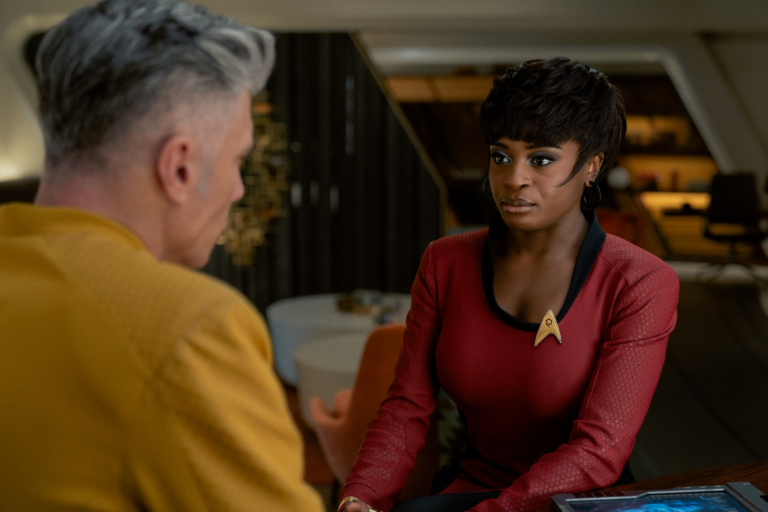
Uhura, in particular, gets a strong showing. Her solution to the Andorian pirates is not simply firing a weapon until the problem disappears. She turns their communications equipment into a high-frequency weapon, using the skills and training we already know she has before grabbing one of their rifles when things become desperate.
It is clever, messy, and dangerous without suddenly turning Uhura into someone she has never been.

Her relationship with Cadet A’Sha also gives the story more emotional purpose than I gave it credit for the first time around. A’Sha ultimately decides that Starfleet is not for her, and Uhura initially treats that decision as a personal failure. She has been trying to mentor her, wants to prove she can help someone else find their place, and discovers that sometimes the right outcome is simply allowing somebody to decide that this is not the life they want.
Pike sees something different in what happened. Uhura adapted, thought on her feet, disobeyed an order when somebody’s life was at stake, and found a way to get everyone out.
Her promotion to Lieutenant Junior Grade is obviously another step towards the Uhura we know from The Original Series, and Strange New Worlds has not always been subtle about arranging pieces into their familiar positions. This one worked for me, though. Uhura actually does something substantial enough for the promotion to feel earned, and seeing her recognised at the end of the episode was genuinely satisfying.
M’Benga’s role is more complicated.
His decision to protect George Kirk’s secret all those years gives the episode much of its emotional weight, while his later choice to take responsibility for drugging Reeger is clearly meant as an act of reparation towards Jim. He has already watched one generation of Kirks suffer because of Reeger and refuses to let it happen again.

I understand why he does it. I am less convinced that the episode should have gone there.
M’Benga taking the fall shifts the final emphasis away from the person I most wanted to see answering questions.
Reeger spends the episode commandeering the Enterprise, pursuing what is increasingly obviously a personal vendetta, ordering the deaths of 5,321 people without sufficient evidence, threatening Jim and Sam Kirk, physically attacking Kirk, and finally having the truth about his supposedly legendary military career exposed.
After all of that, I wanted to see him face Starfleet.
That is where I think “Orders of Magnitude” should have ended. Put Reeger on a shuttle, take him back to Starfleet Command, and leave him knowing that for the first time in decades he is going to have to explain himself. Not only General Order 24 and what nearly happened on Argus II, but Zeta Reticuli as well. Let the institution that built his legend finally ask how much of that legend was actually true.

Instead, the episode moves the focus towards M’Benga protecting Kirk and another layer of secrecy.
Perhaps that is intentionally uncomfortable. George Kirk covered for Reeger. M’Benga protected that secret. Now M’Benga creates another one to protect Jim. The episode is full of people lying for reasons they believe are honourable, only for those lies to leave somebody else carrying the consequences.
But I still wanted Reeger to have his reckoning.
Because that is what the story has been building towards. Reeger has spent years living inside a story about himself. George Kirk helped preserve it, M’Benga protected it, Starfleet celebrated it, and officers who never served with Reeger absorbed that mythology deeply enough that La’an struggles to question him when he is standing right in front of her behaving appallingly.
Jim Kirk is the person who finally tears the story apart.
There is a lovely irony in that. Reeger repeatedly treats Kirk as an impulsive junior officer who does not understand the burden of command, yet Kirk is the person on the bridge thinking most seriously about what command actually means.
Reeger has rank. Kirk has responsibility.

Those are not the same thing.
“Orders of Magnitude” is not perfect. Pike and Una leaving the ship still feels engineered to make the main plot possible, the crew takes too long to challenge an order that should immediately horrify them, and the ending denies Reeger the direct reckoning I wanted after spending an hour exposing exactly who he is.
But it is a strong episode, and one that improved for me on a second watch.
Joe Morton gives it a character I genuinely dislike watching while also giving one of the strongest guest performances of the season. Paul Wesley continues to grow into a James T. Kirk I now actively enjoy seeing. Uhura gets to be intelligent, brave, adaptable, and then receives a promotion that, despite the obvious continuity machinery behind it, feels deserved.
Most importantly, “Orders of Magnitude” understands something Star Trek has returned to again and again: institutions do not live up to their ideals automatically. Rank does not make somebody right, reputation does not make history true, and sometimes protecting an institution means being willing to challenge the story it tells about itself.
Sometimes it just takes a Kirk willing to call the bluff.
7.5/10