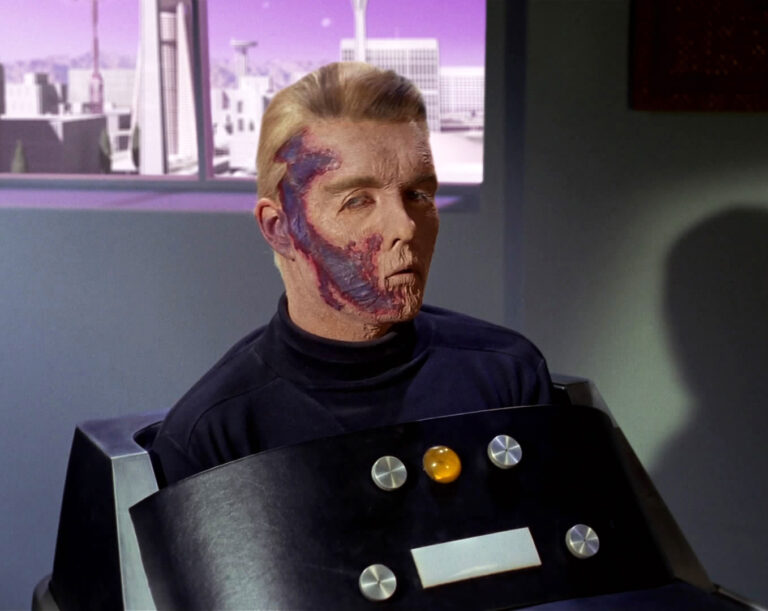

Star Trek TOS, “The Galileo Seven” (S01E16) Review
“Strange. Step by step, I’ve made the correct and logical decisions. And yet two men have died.”
That is the line I keep coming back to in “The Galileo Seven”. Spock has done what he believes he is supposed to do. He has assessed the information, made rational decisions, followed them through, and somehow ended up with two men dead, the Galileo surrounded by enormous hostile creatures, and the people under his command barely trusting him.

The obvious reading is that Spock learns logic is not enough and needs to discover a little human emotion. I think the episode is much more interesting than that, even if the script occasionally tries to force it into those terms. Spock’s problem is not logic. His problem is that he keeps working from an incomplete picture.
Spock Gets the Chair
The Enterprise is carrying urgently needed medicines to Makus III, where they will be transferred to the plague-stricken New Paris colonies, when Kirk takes the opportunity to investigate Murasaki 312. He is under standing orders to investigate phenomena like this, so it is not simply Kirk getting distracted by something interesting in space, although High Commissioner Ferris behaves as if it is.
The Galileo is pulled off course and forced down on Taurus II. Communications are gone, the Enterprise cannot find them, the shuttle has lost a huge amount of fuel, and Scotty quickly works out that they are carrying too much weight to reach orbit.
Then the locals turn up.

This is where the episode really works for me. Everything makes the next problem worse. The crash causes the fuel problem, the fuel problem creates the weight problem, the isolation makes the Taureans more dangerous, and Latimer’s death starts pulling the crew apart. Meanwhile, Kirk has Ferris watching the clock because, inconvenient though he may be, the man is also right that thousands of sick people cannot wait forever while the Enterprise searches for seven missing crew.
It gives the whole episode a proper structure. Nothing feels like it has been thrown in simply because the last obstacle was not exciting enough.
There is some lovely world-building around it too. The Galileo finally makes shuttle operations feel like a real part of life aboard the Enterprise. Murasaki 312 has a scientific purpose rather than just being this week’s colourful thing in space, and Uhura temporarily takes over the science station and identifies Taurus II as a Type M world capable of supporting human life.

I especially like that last detail. Uhura is actually doing something technical rather than waiting for someone to hail the ship.
Taken together, those touches make the Enterprise feel more like a functioning exploratory organisation. There are specialists, procedures, classifications, different jobs, and equipment designed for different missions. You can feel Star Trek beginning to grow into the larger, more textured universe I grew up with.
Logic Is Not the Problem
Spock understands the things he can measure. The Galileo’s weight, the fuel, the probability of reaching orbit, the usefulness of the phasers, and the steadily shrinking number of options available to them.
What he understands much less well are the frightened and grieving people standing beside him.

That is where I think the episode becomes far more interesting than a simple logic against emotion story. Spock treats the crew’s feelings as something happening around the problem, almost like interference, when they are actually part of the problem.
His reaction to Latimer’s death is the clearest example. There is a perfectly sensible argument for not stopping everything to hold a burial while the shuttle is damaged and hostile creatures are nearby. But whether the burial is tactically sensible is not the only question. A commander also needs to recognise what that death has done to the people still alive.

Spock does not.
He makes the same mistake with the Taureans. He assumes that showing them the destructive power of the phasers will frighten them away. When they respond with even more aggression, he seems genuinely surprised. McCoy points out that anger was hardly an impossible response, and for once I completely agree with him.
Spock is being logical, but his inputs are wrong.
Human psychology is information. Morale is information. The behaviour of an unknown opponent is information. If the people under your command are frightened, angry, grieving, and losing faith in you, those things do not stop mattering simply because they are emotional.

That is why his admission about making the correct decisions and still losing two men lands so well. He is not discovering that logic is useless. He is discovering that being able to reason through a problem is not the same thing as being able to lead people through it.
Scotty Just Gets On With It
While all of this is happening, Scotty quietly becomes my favourite person in the episode.
Everyone else is arguing about logic, grief, authority, fear, and whether Spock has a heart. Scotty is trying to fix the shuttle.

The Galileo has lost fuel, so he works the problem. Eventually he realises he can modify the system to draw power from their phasers, which means giving up their best defence in return for the possibility of actually getting off the planet.
No grandstanding, no sulking, and no need to turn every decision into a referendum on Spock’s personality. He just does his job.
James Doohan is excellent here because Scotty becomes the calm centre of the whole story. He disagrees when the engineering reality demands it, but he never seems to forget that Spock is in command.
That feels right.
The same cannot be said for everyone else.

McCoy and Boma Push It Too Far
Boma starts well. Don Marshall makes him intelligent, capable, and willing to challenge assumptions, which is exactly the sort of officer Spock should need around him. There is a real difference between questioning a decision and undermining the person making it, though, and Boma eventually crosses that line by some distance.
By the second half of the episode he is openly mocking Spock, challenging him in front of everyone else, and treating orders as if they are suggestions.

I understand why he is angry. I understand why Gaetano’s burial matters to him. I even think Spock handles parts of the situation badly. But there comes a point where Boma stops looking like an officer under pressure and starts looking like someone who has forgotten he works in a chain of command.
McCoy bothers me even more.
Not McCoy generally. McCoy in this episode.

He should be the most useful person Spock has. McCoy understands people in a way Spock does not, and he can see that Spock is losing the crew even when many of his decisions remain defensible. He could help bridge that gap.
Instead, he spends far too much time widening it.
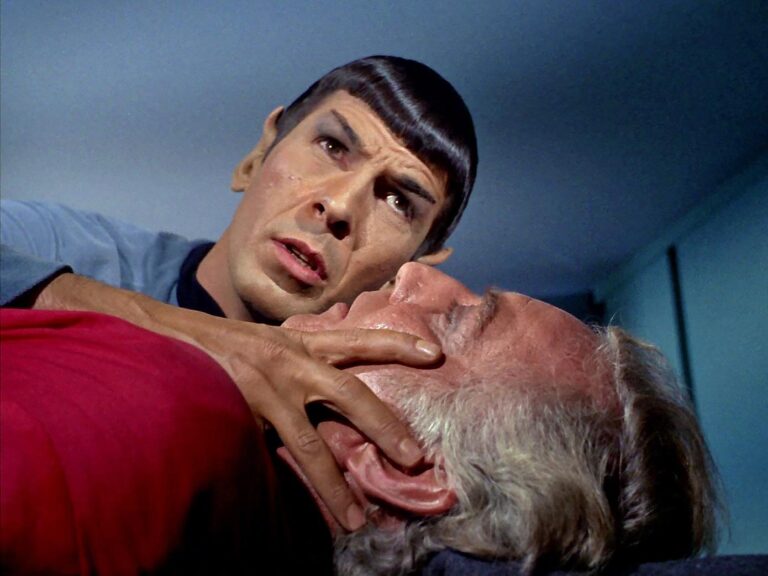
He undermines Spock openly in front of junior officers, takes digs at his Vulcan nature, and repeatedly treats his lack of visible emotion as evidence that he simply does not care. There is a cultural nastiness to some of it that becomes harder to dismiss as familiar banter the longer the episode goes on.
“So ends your first command” is the point where it really turns for me.

They believe they are about to die. Two men from the Galileo party are already dead. Spock thinks the remaining crew will die because of decisions he made, and McCoy chooses that moment to make sure he knows he has failed.
That is not compassion. It is just cruel.
The frustrating thing is that McCoy is right about the underlying problem. Spock is losing the crew because he does not understand what they need from him, but McCoy repeatedly makes the situation worse while congratulating himself for understanding it.
Scotty, somehow, is the only person who appears to realise you can disagree with your commanding officer without turning the shuttle into a workplace grievance meeting.
A World Built in Fog
The visual side of “The Galileo Seven” helps enormously because Taurus II should probably look ridiculous.

It is fog, rocks, giant furry humanoids, and enormous spears on a television budget from 1966. Yet most of it works because Robert Gist does not show too much. We see shapes in the mist, movement beyond the rocks, and weapons arriving before we get a good look at whoever threw them.
The Taureans feel larger because the episode lets us imagine their scale.
Inside the Galileo, everything is cramped and increasingly uncomfortable. Spock feels physically trapped with people who no longer trust him. Outside, visibility disappears and nobody has any real control over what is around them.
That visual contrast fits the story better than some of the dialogue does.

The shuttle itself also has a satisfying solidity to it, along with little details such as the phasers stored together and Scotty physically working on systems rather than waving a scanner at them. The remastered effects give the Galileo and Murasaki 312 a sense of scale the original production could only suggest.
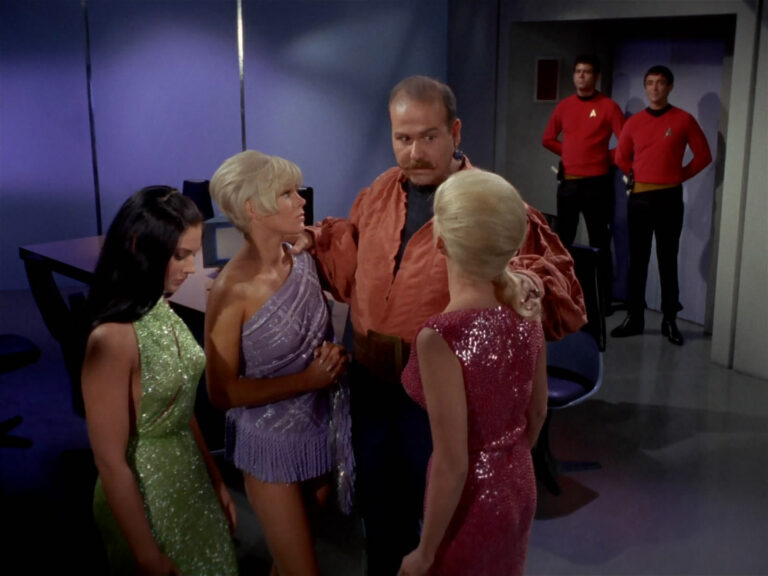
And then there is Ferris’s little cape-sleeved outfit, which is magnificent in precisely the way only 1960s Star Trek clothing can be. You know he is going to be unbearable before he even opens his mouth.
The Gamble
The best part of Spock’s command comes right at the end.

The Galileo makes it into orbit, barely, but Spock has already used the boosters escaping the Taureans and there is no safe way back down. The Enterprise appears to have abandoned the search. They are going to die in a decaying orbit.
So Spock jettisons and ignites the remaining fuel.
Everyone immediately takes this as proof that he has finally abandoned logic and done something emotional.

I am not convinced he has.
If every available choice ends in death and one action carries even a tiny possibility of attracting the Enterprise’s attention, taking that chance is not irrational. Spock chooses the only remaining option that contains any possibility of survival.
What interests me is that he cannot entirely explain the impulse himself.
For once, desperation, instinct, calculation, and hope have all arrived at the same answer, and even Spock seems unsure exactly where one ended and another began.
That is a much more interesting ending than simply saying he finally did something human.

Unfortunately, then everybody laughs at him.
The final bridge scene still jars. Kirk teasing Spock about whether the fuel dump was an emotional act is completely in character, and Spock desperately constructing logical justifications for it is funny.
The group laughter feels different.
Latimer and Gaetano are dead, and Ensign O’Neal has also been killed during the Enterprise search operation. Three crewmen have died during the incident. Spock has just survived his first command after spending several minutes believing he had killed everyone under him, and the episode ends with everyone having a chuckle at the Vulcan.
It feels like a sitcom ending bolted onto a much better story.
The episode deserved another thirty seconds of weight.
Being Right Is Not Enough
“The Galileo Seven” works because Spock does not really learn that logic is wrong.
He learns that command is about more than making a correct decision.

The crew have legitimate reasons to be frustrated with him, but several of them behave appallingly. McCoy sees the weakness in Spock’s leadership while actively making that weakness harder to overcome. Spock keeps making rational decisions without recognising that the people carrying them out are variables too.
And Scotty fixes the shuttle.
I admire what this episode is trying to do slightly more than I enjoy every moment of watching it. The crew hostility becomes exhausting, McCoy comes out of it considerably worse than I suspect the writers intended, and the script’s argument about logic is much cruder than the story underneath it.
But that underlying story is excellent.
Spock begins “The Galileo Seven” believing command is another problem that can be solved if he thinks clearly enough. By the end, logic has not failed him. What has failed is the assumption that being right is the same thing as being effective.
People still have to follow you.
That is the part Spock has not learned yet.
8/10