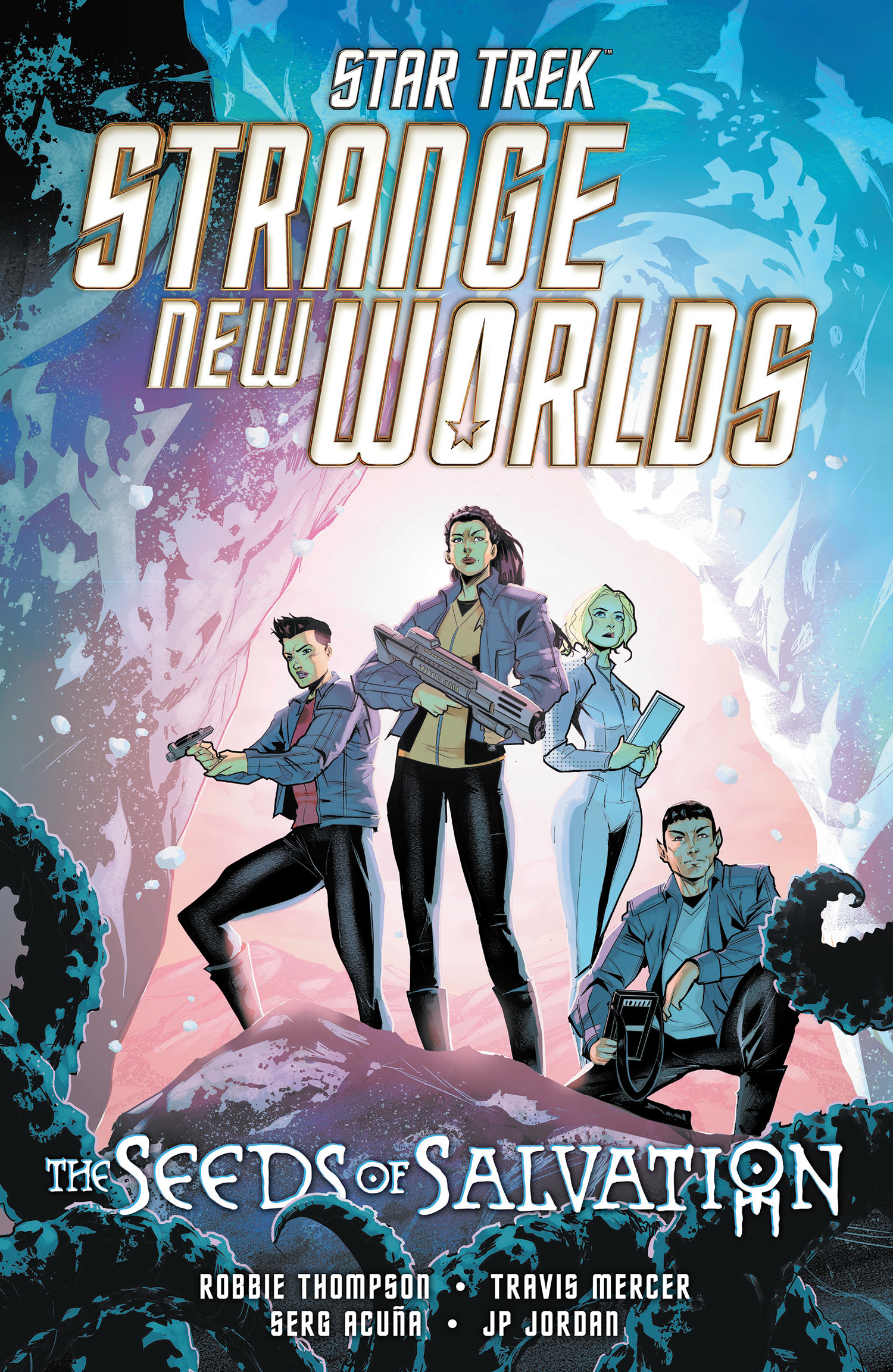
Star Trek: Strange New Worlds — The Seeds of Salvation TPB (Review)
Written by Robbie Thompson
Art by Travis Mercer and Serg Acuña
Colours by JP Jordan
Letters by Jodie Troutman
Published by IDW
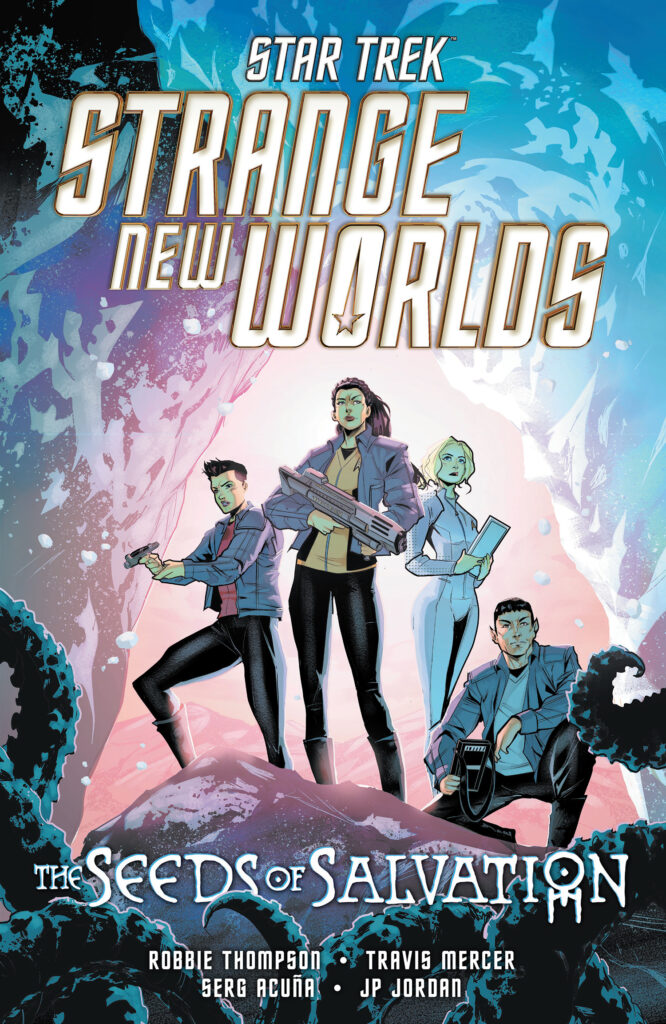
Star Trek: Strange New Worlds — The Seeds of Salvation collects the five-issue IDW miniseries. Cover artwork by Travis Mercer and JP Jordan.
There is a particular kind of boredom that only Starfleet could produce. You cross distances that would have been unimaginable a few centuries earlier, set foot on planets nobody has ever visited, and discover entirely new forms of life, only to find yourself wondering when something exciting is finally going to happen.
That is where Christine Chapel begins The Seeds of Salvation. After a run of perfectly safe, largely uneventful missions, she is restless. The Enterprise is still exploring the unknown, but lately the unknown has consisted mainly of empty rocks, harmless organisms, and everyone returning to the ship without being chased, possessed, eaten, or otherwise spectacularly inconvenienced.
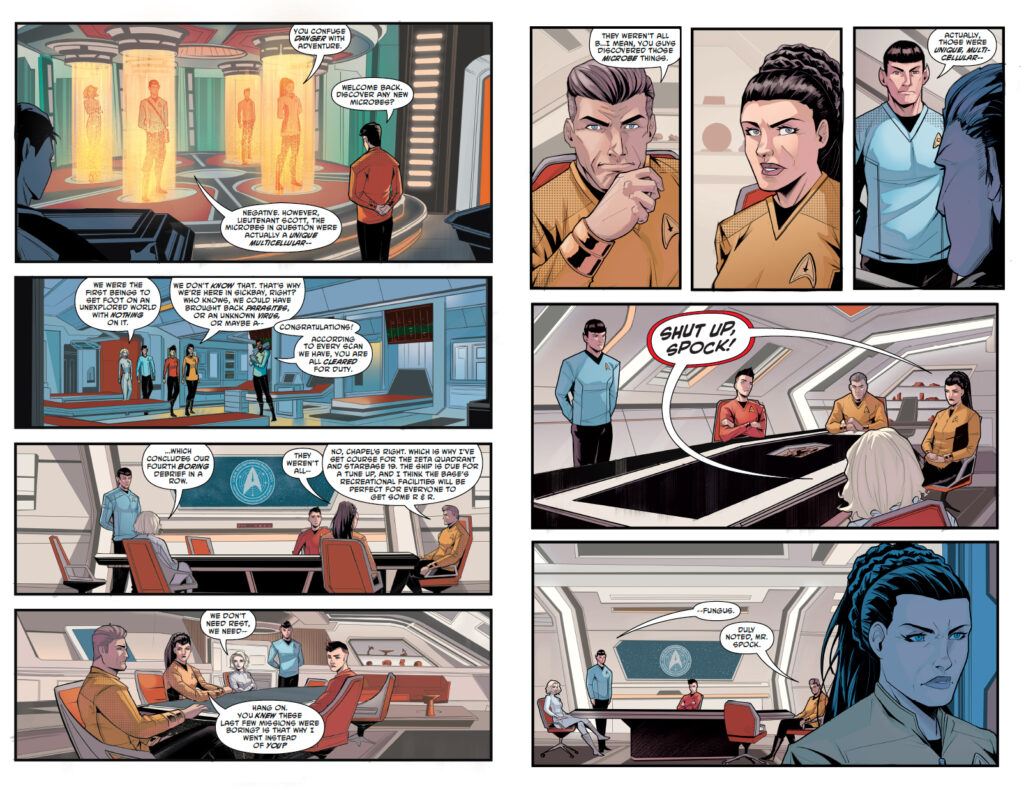
Una sees the problem more clearly than Chapel does, she is confusing danger with adventure.
It is the line around which Robbie Thompson builds the entire story. Chapel wants something to happen. What she gets is an abandoned research station, an ocean hidden beneath miles of ice, enormous tentacled creatures, an ancient prison, a body-stealing collective, and considerably more adventure than she had in mind.
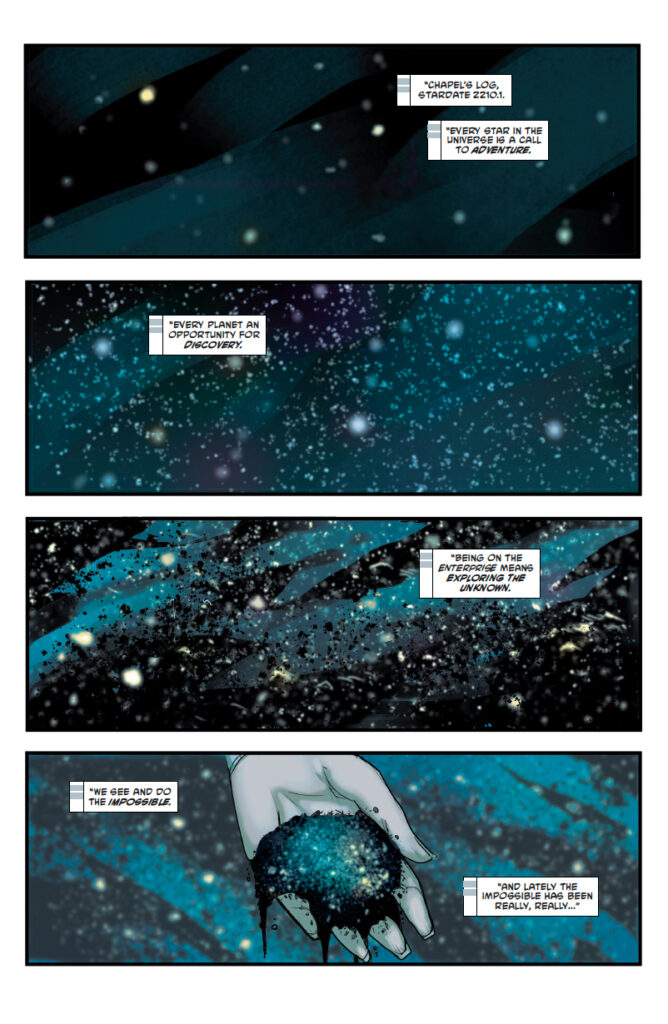
Christine Chapel reflects on exploration, and her growing boredom, as the story begins.
Chapel refuses to stand at the back
I never disliked Christine Chapel in “The Original Series“, but I never found her especially interesting either. She often felt passive, rather wet, and defined more by how she felt about Spock than by anything she was allowed to do herself. She was there, she was perfectly fine, and that was about the extent of it.
The Chapel introduced in “Strange New Worlds” is almost an entirely different character, but it is a change I can get right behind. She is bold, brash, impatient, funny, occasionally reckless, and far more willing to push herself into the centre of events. Between the television series and this book, I have gone from never minding Chapel to genuinely loving her.
She reminds me a little of my wife, which may explain part of it.
The Seeds of Salvation understands how much energy this version of Chapel brings to a story. She is not simply the member of the away team with a personal connection to the missing scientists. Her restlessness begins the journey, her friendship with Jinare gives it emotional weight, and her choices carry the story through its increasingly strange second half.
Jinare served alongside Chapel during the Klingon War and has since devoted herself to researching ways of protecting vulnerable planets. Her work on Poilant concerns the world’s unusual ice, which prevents sensors from penetrating beneath its surface. If its properties can be reproduced, entire planets might one day be shielded from hostile surveillance.
It is serious research shaped by their shared experience of war. Unfortunately, when the Enterprise reaches Poilant, Jinare and her team have disappeared.
Chapel joins Una, Spock, La’An, Scotty, and the research station’s robot assistant, D6, on a rescue mission into the frozen planet. What begins as a search for five missing scientists gradually becomes something far older and much larger.
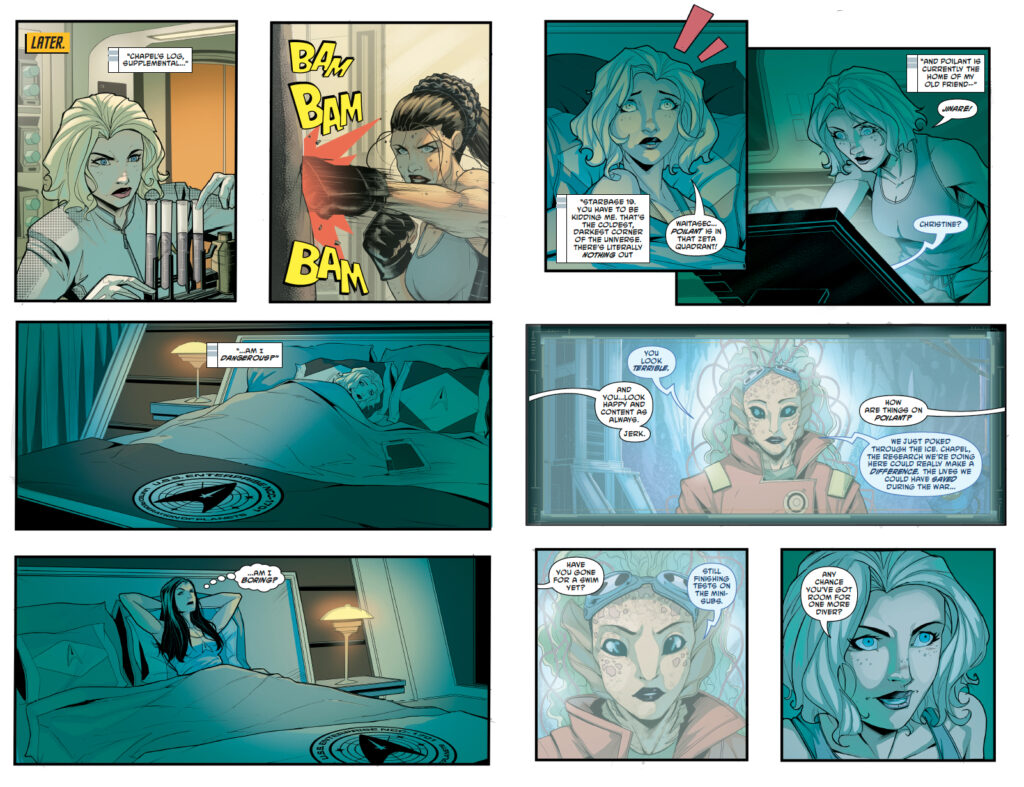
Chapel reconnects with her old friend Jinare, whose research has brought her to the frozen world of Poilant.
Taking the long way down
The opening issue is slow, but I mean that more as a description than a criticism.
Thompson takes time to establish Chapel’s dissatisfaction, her relationship with Una, the rhythm of the crew, and why Jinare’s disappearance matters. We know the book is heading towards underwater horror, the tentacles on the cover are not especially subtle, but it resists throwing everything at us before the characters and stakes have been established.
I appreciate a story willing to build tension rather than sprint towards its first large action scene. The structure is classic Star Trek: a competent away team enters an apparently abandoned facility, follows the evidence, and slowly realises the situation is nothing like the one they were expecting.
The first issue feels much more like setup than payoff, but the collected format helps enormously. There is no month-long wait between the team beginning its descent and the creatures beneath the ice revealing themselves. The mystery continues immediately, and the patience starts paying off.
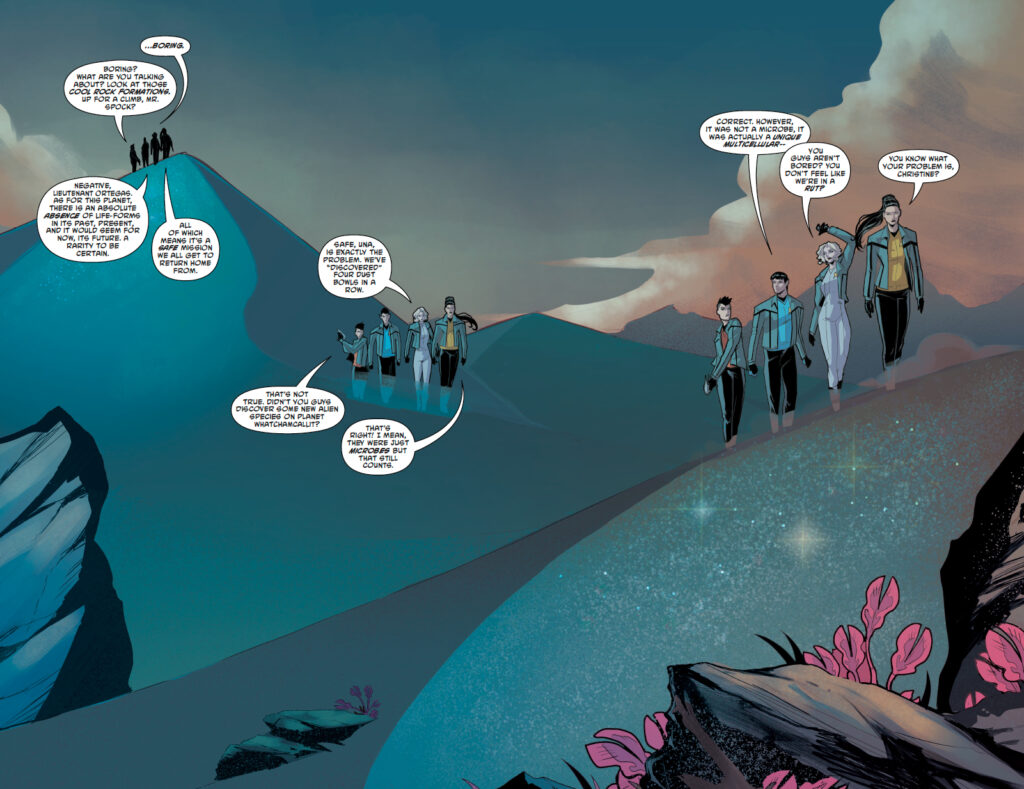
Another uneventful planetary survey leaves Chapel wondering whether the crew has fallen into a rut.
The revelation that Poilant is an ancient prison world is exactly the sort of escalation I enjoy in Star Trek. The horror is not simply a hungry monster waiting in a cave. It is an old mistake that has continued causing harm long after the people responsible disappeared.
The prison was created by the Arken, a technologically advanced civilisation whose machines eventually came to dictate morality, guilt, and punishment. Its prisoners include the Seed, a plant-based collective that has survived there for centuries, while Poilant’s native inhabitants have been trapped beneath an artificial ocean of ice by machinery they never asked for.
It gives the story the same kind of structural depth I enjoyed in Holo-Ween. The frightening thing in front of the crew is connected to history, institutional failure, and consequences that have been abandoned for somebody else to inherit.
Horror in the deep
My wife and I are both huge horror fans, so Star Trek moving into horror territory is nearly always going to get my attention.
The Seeds of Salvation gives us abandoned corridors, enormous shapes moving through black water, researchers suspended inside writhing vines, bodies repurposed as extensions of an alien consciousness, and a starship gradually disappearing beneath a living mass.
The threat itself is not wildly original. Ancient prisons, hive minds, tentacles, possession, and dangerous things buried beneath the ice are all familiar pieces of science-fiction horror. The comic rearranges recognised ingredients rather than presenting something we have never encountered before.
What makes it work is that the danger is not merely physical.
The Seed controls Jinare and the other researchers, using their bodies as both power sources and puppets. It promises peace while removing choice, and seeks freedom by imprisoning everyone it encounters. The victim of an ancient injustice has gradually adopted the methods of its captors.
The tentacles may be familiar. What the Seed does to the idea of freedom is far more interesting.
I do have one considerable personal obstacle here, I cannot stand stories where a crew member falls under alien influence. Mind control, possession, amnesia, and conveniently forgetting everything sit together in a box of tropes I would happily launch into the nearest sun.
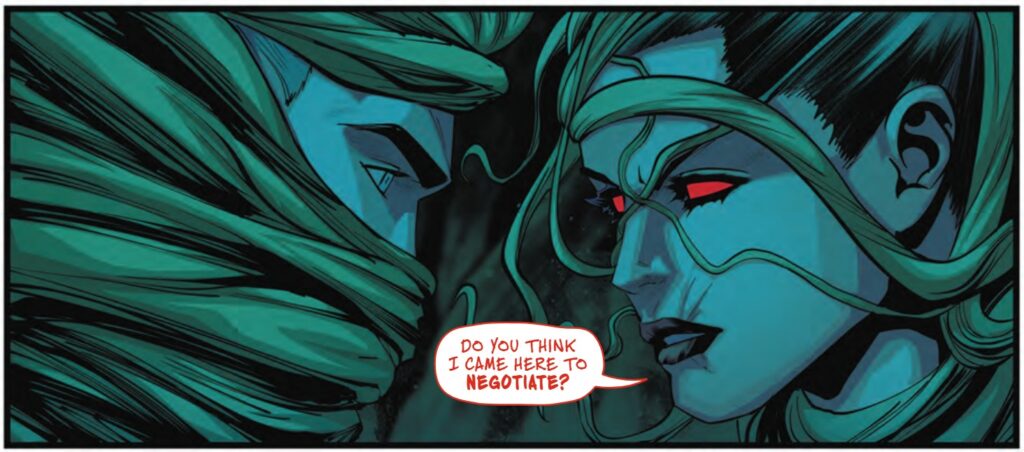
The possession is thematically appropriate and produces some of the book’s strongest imagery. I still groaned when the story went there.
Two artists and one obvious divide
Travis Mercer draws the first two issues, while Serg Acuña takes over for the remaining three. JP Jordan colours the entire collection, which gives the book some visual continuity, but the change in artist is impossible to miss.
Mercer is particularly strong when establishing alien environments and scale. The barren survey planet, the Enterprise approaching Poilant, the frozen research complex, and the early underwater sequences all feel large and properly unfamiliar. His figures caught inside the vines are distorted, eerie, and effective.
His character likenesses are more mixed. Some faces work well, while others become stylised enough that recognition briefly depends more upon uniforms and hairstyles than the actors they represent. It never makes the book difficult to follow, but it occasionally pulls me out of a scene.
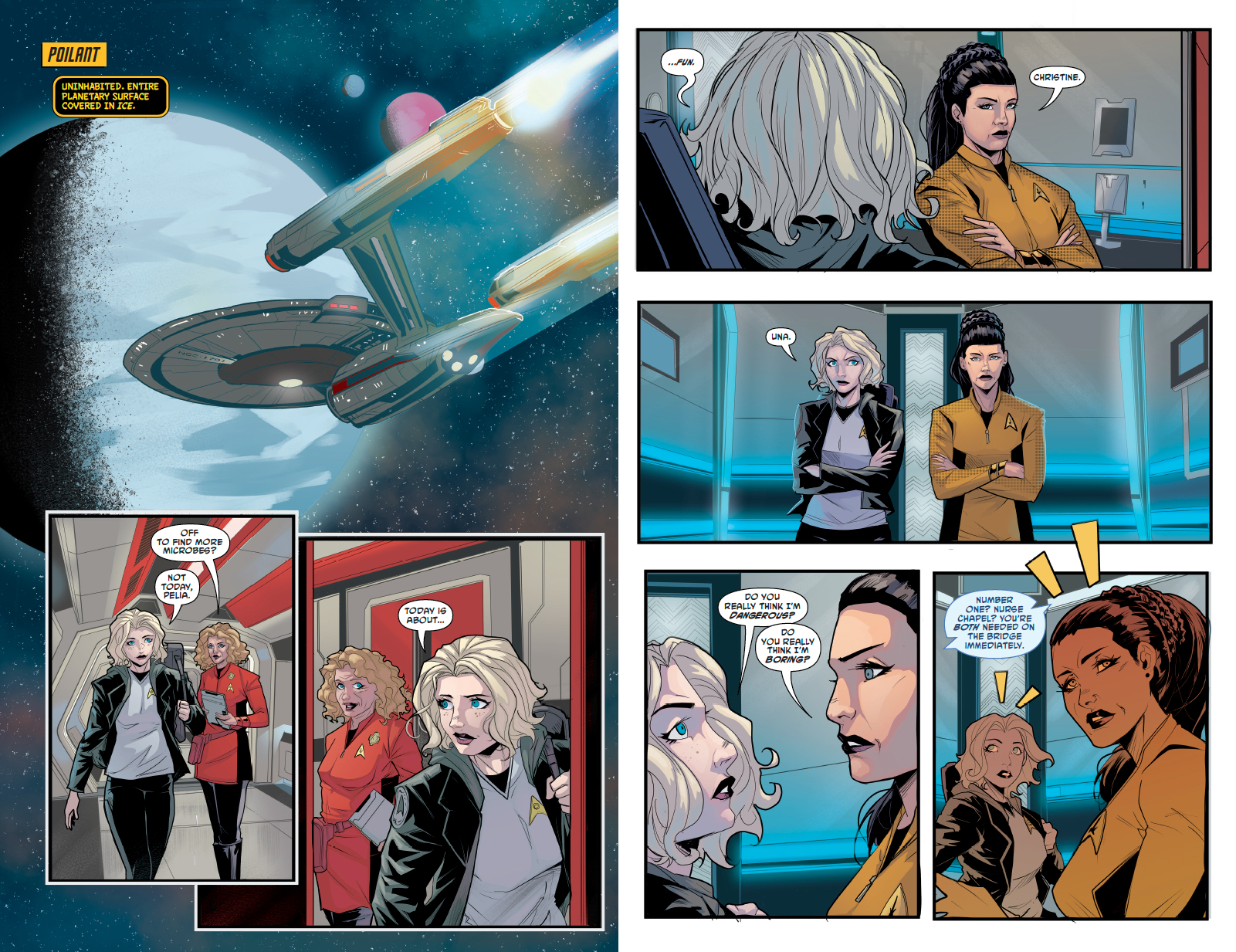
The Enterprise arrives at Poilant after contact with Jinare’s research team is lost.
Then Acuña arrives, and for me, the artwork takes a considerable step upwards.
His pages are darker, more expressive, and better suited to the increasingly organic horror. The Seed’s vines feel heavier and more invasive, the action has stronger movement, and the larger splash pages carry a real sense of danger. His submersible sequences are excellent, and the later battles are visually dense without becoming impossible to follow.
Ortegas’s piloting scenes deserve particular mention. Their framing and movement give them genuine energy. The ship does not merely sit in the middle of a panel while the dialogue insists it is travelling quickly, the artwork sells the speed, instability, and barely controlled momentum.
The contradiction is that I hated the art changing halfway through the story, but preferred the artist who took over. Acuña’s work is excellent, and I wish he had drawn all five issues. A collected story benefits from visual consistency, and the shift is jarring even when it represents an improvement.
The series was originally announced with Thompson and Mercer as the creative team, but no reason for the change appears to have been publicly confirmed. Whatever happened behind the scenes, it becomes far more noticeable when all five issues are read together.
Jordan’s colours help hold the two approaches together. The frozen blues and teals create a convincing underwater cold, while the Seed’s dark greens and blacks gradually consume the cleaner Starfleet environments. The occasional warmer sequence, particularly Chapel’s memories of Jinare, immediately feels safer and more human.
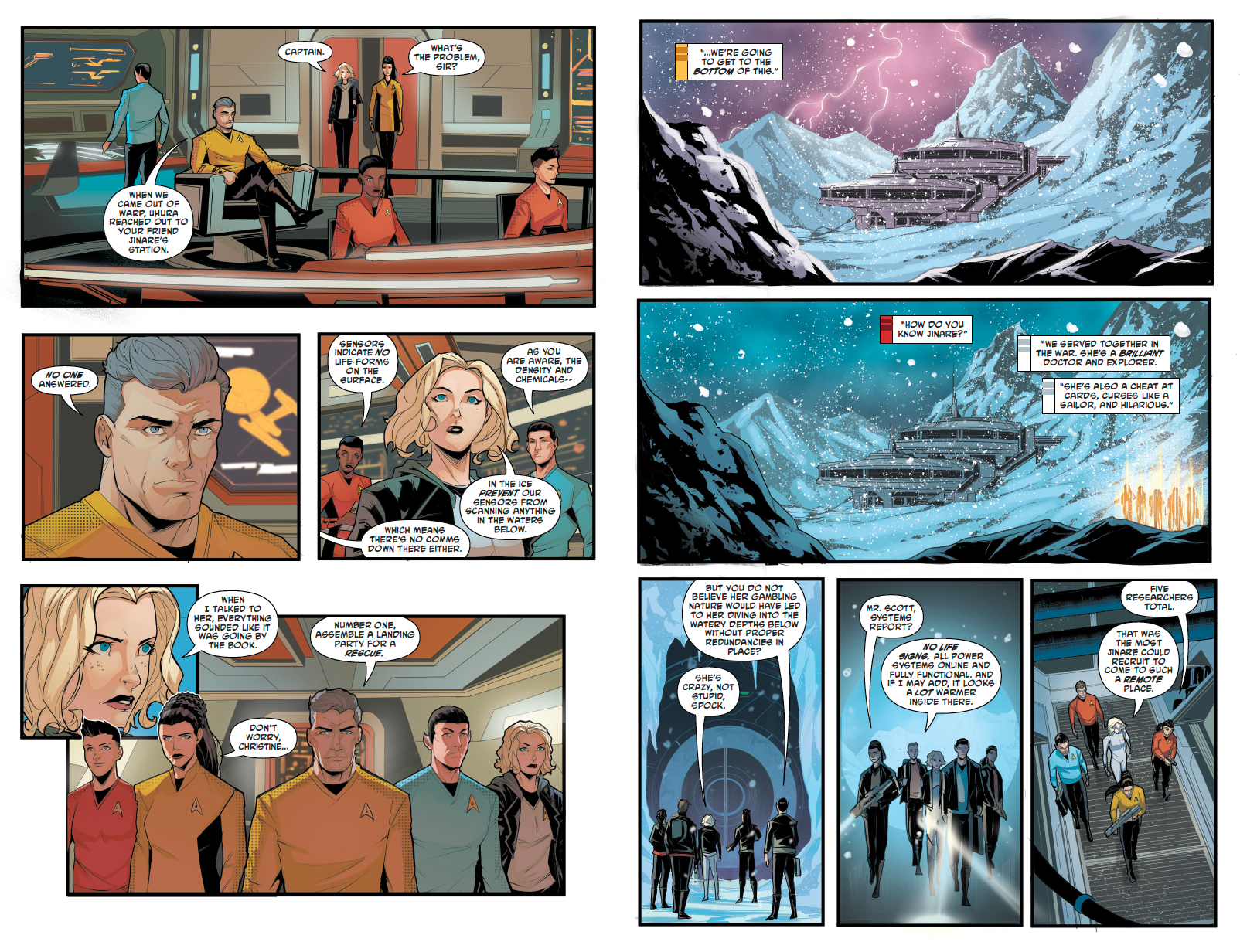
Una leads Chapel, Spock, La’An, and Scotty into Jinare’s abandoned research facility.
D6, unfortunately
D6 is the research station’s robot assistant, comic relief, exposition delivery system, and eventually the centre of one of the story’s more serious emotional turns.
I found him annoying almost immediately.
I understand what Thompson is doing with him. D6 has been given expanded consciousness but has mostly used it to discover an impressive range of fears. He is frightened of water, confined spaces, danger, death, and almost everything that might occur between those points. His eventual arc is about acting despite that fear rather than magically becoming fearless.
Structurally, it works. Emotionally, his final choice has weight.
The problem is that his quips become increasingly grating as the story continues. He keeps announcing his fear in slightly different ways, long after the joke has established itself. Instead of releasing tension, he often interrupts it.
By the later issues, every new D6 comment made me like him slightly less. His completed arc did not make me wish I had spent more time with him.
There are similar voice problems elsewhere. The comic captures the broad informality of Strange New Worlds, but Spock receives too many jokes built around correcting somebody and being told to stop talking. Scotty also leans towards comic panic more often than I would have liked.
Speaking of Scotty, I would have liked considerably more of him. He contributes to the rescue and keeps damaged equipment functioning, but he never receives enough space to become a major part of the story. That is partly personal bias, admittedly. A comic can nearly always be improved by adding Scotty until somebody sensible intervenes.
Freedom, revenge, and the prison that follows you
The Seed is not wrong about what happened to it.
The Arken devastated its world, imprisoned its survivors, and left them trapped for centuries. Its anger is justified. Its decision to possess innocent people, steal their bodies, and attack anyone standing between it and revenge is not.
That distinction gives the final act its Star Trek core.
The crew eventually discovers that the Arken are already extinct. The technological system that came to control their morality also destroyed them. There is nobody left upon whom the Seed can take revenge, only unrelated people it can continue hurting because it no longer knows what else to do with its suffering.
Pike does not excuse what the Seed has done. He gives it a choice, continue rebuilding its identity around captors who no longer exist, or accept the chance to create a future somewhere else.
The resolution comes through diplomacy, compassion, and self-reflection rather than simply blasting the alien vessel apart. That is exactly the kind of ending this story needs.
It is also slightly too tidy. The Seed moves from centuries of rage to accepting relocation rather quickly, and the final issue has a lot of problems to solve within very few pages. The terraformer, the trapped Poilantians, the possessed crew, the missing researchers, the attacking vessel, and the melting planet all need conclusions.
The book lands them, but you can feel how crowded the runway has become.
Adventure is not the problem
Chapel begins the story believing something has gone wrong because Starfleet life has become safe and predictable. Jinare makes a similar mistake, pushing ahead before completing every scan because she is desperate for progress and, ultimately, bored herself.
Both women are wrong about why they need to move, but neither is wrong to care.
Jinare’s research could protect vulnerable planets. Chapel’s insistence on going to Poilant saves Jinare, frees the Seed, and gives the Poilantians their world back. The story cannot honestly argue that caution would have produced a better outcome.
Its point is more interesting than “be careful what you wish for”. Adventure is not the same as danger, and danger is not evidence that something matters.
Chapel succeeds because she refuses to abandon her friend, pays attention to what is around her, and keeps acting when the excitement she wanted becomes frighteningly real. She does not finish the story as a quieter, safer version of herself. She simply understands her own restlessness slightly better.
That is why she works so well as the emotional anchor. The cosmic prison and ancient species give the book scale, but Chapel gives it a pulse.
The Seeds of Salvation is a strong, horror-flavoured Star Trek adventure. It takes its time establishing the mystery, gives Chapel a proper emotional journey, uses the full crew effectively, and reaches a compassionate conclusion without pretending its antagonist has done nothing wrong.
Acuña’s later artwork is excellent, even though the change from Mercer is distracting. The horror imagery works despite relying on familiar ingredients, and the philosophical material gives the action more weight than the tentacles alone could carry.
D6’s constant quips tested my patience, the possession trope remains one I would happily never encounter again, and the story could have found far more for Scotty to do. Those weaknesses stop it short of becoming one of IDW’s very best Star Trek collections.
With Acuña drawing all five issues and a little more Scotty, this could easily have reached a nine.
As published, it is a very good 8/10 (Without the art change and more Scotty I reckon it could have been a 9).