
Star Trek: Strange New Worlds – “Off-Hour” (S04E06) Review
There is something wonderfully mundane about a disaster arriving just as everyone is trying to finish work.
The Enterprise is caught in that strange little gap between shifts. People are winding down, responsibilities are being handed over, and mentally, at least, some of the crew are already off the clock. Then the ship falls into a slipstream wormhole, loses power, and suddenly nobody is going anywhere. Instead, they have less than an hour to stop the Enterprise being pushed beyond a catastrophic warp threshold and torn apart.
After last week’s “Level-Five Transporter Accident”, I needed this.
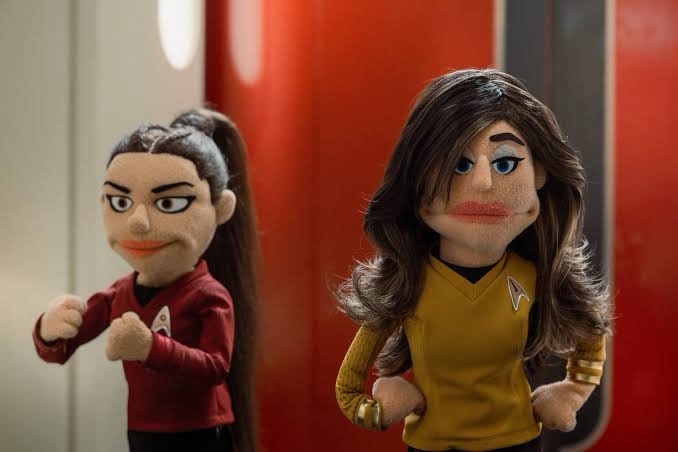
Not simply because “Off-Hour” is serious, or because there are no puppets fighting pirates, but because it feels like Strange New Worlds remembering that Star Trek doesn’t always need another costume to wear. Sometimes a starship breaking around a group of highly trained people is more than enough, and “Off-Hour” is very good at breaking the Enterprise.

The episode unfolds in real time, with a countdown running alongside events as the crew becomes scattered throughout the ship. There is an obvious touch of 24 in the clock and occasional split-screen compositions, while the basic structure immediately recalls The Next Generation’s “Disaster”. Those comparisons are unavoidable, but neither really matters unless the format actually earns its place here.
For the most part, it does.
Season 4 has increasingly felt as though somebody starts each writers’ meeting by asking what kind of television Star Trek hasn’t impersonated recently. That isn’t inherently a problem. Trek has always played with genre and format, and some of its best episodes exist because somebody decided to stretch what the show could be. The problem comes when the experiment becomes more interesting to the production than the people living inside it.
“Off-Hour” gets that relationship the right way round because the clock isn’t the story. It tightens the story.
Every decision costs time, movement around the ship becomes difficult, communication is compromised, and people who would normally solve these problems together are forced into smaller groups. There is no convenient gathering of senior officers around a conference table while somebody explains the anomaly on a screen. Everyone has whatever information, equipment, and people happen to be nearby, and they have to work from there.

That is where the comparison with “Disaster” becomes more interesting than simply saying both episodes involve a crippled Enterprise.
That episode separated the crew of the Enterprise-D and repeatedly put people outside the roles in which they were most comfortable. Troi finds herself responsible for the ship, Worf has to deliver a baby, and Picard ends up trapped with children. “Off-Hour” isn’t doing exactly the same thing, but it understands the same basic pleasure: watching capable people continue functioning after the structure supporting them has fallen apart.
Here, the Enterprise almost stops being one ship and becomes a series of isolated workplaces. Engineering has its own crisis, Sickbay has another, and crew members are cut off from the people they would normally depend upon. The shift change makes that even better because some of them weren’t supposed to be dealing with any of this in the first place.

That detail might actually be my favourite part of the whole setup.
Anyone who has worked somewhere with handovers knows how vulnerable that little period can be. One group thinks it is finished, another is only just arriving, information is moving between people, and inevitably something chooses exactly that moment to go horribly wrong. Turning that ordinary bit of workplace friction into the foundation of a starship disaster gives the episode a strangely believable texture.
It also reminds me of something Star Trek occasionally forgets about itself: these people have jobs.
They aren’t simply heroes waiting for this week’s adventure. Somebody has to monitor the engines, staff Sickbay, maintain the ship, hand responsibilities over, and presumably spend part of their shift wondering whether the person relieving them is actually going to turn up on time. “Off-Hour” gets a surprising amount of tension simply by taking that workplace seriously.
The strongest material, though, belongs to Chapel and M’Benga.

When M’Benga becomes trapped beneath a biobed, with his midsection badly crushed, the episode strips their relationship down to something brutally straightforward. He understands his injuries, knows what they mean, and tells Chapel that she needs to stop trying to save him.
She refuses.
What I liked most is that the scene never turns into some grand speech about friendship, Starfleet, or refusing to leave anyone behind. Chapel just keeps working. Her attempt to use improvised cryogenics to buy him more time is exactly the kind of medical problem-solving I like in Trek: desperate, imperfect, and born out of what is actually available rather than a convenient miracle appearing five minutes before the credits.
Jess Bush is particularly good here because Chapel’s refusal never becomes theatrical. She is frightened and increasingly desperate, but she remains a medical professional trying to solve the next problem in front of her. The tighter framing and colder lighting in Sickbay help enormously, making the room feel smaller as M’Benga’s options disappear.
Oddly, though, M’Benga himself annoyed me in this episode, and I can’t entirely explain why.

It isn’t Babs Olusanmokun’s performance, which is strong, and it certainly doesn’t damage the storyline. There was simply something about M’Benga here that rubbed me the wrong way. Maybe it was the repeated fatalism while Chapel was desperately trying to save him, or perhaps it was just the particular tone of those scenes. Whatever it was, I found myself becoming irritated with him when I was clearly meant to be worried about him.
Sometimes a character just annoys you and the neat critical explanation never turns up. I’d rather admit that than invent one afterwards.
Elsewhere, “Off-Hour” gives the engineering side of Star Trek some very welcome attention. Scotty and the others aren’t waving a tricorder around until the computer announces that everything is fixed. The ship feels mechanical, damaged, and increasingly hostile to the people inside it, and Dan Liu’s direction does a lot of the work in making that land.
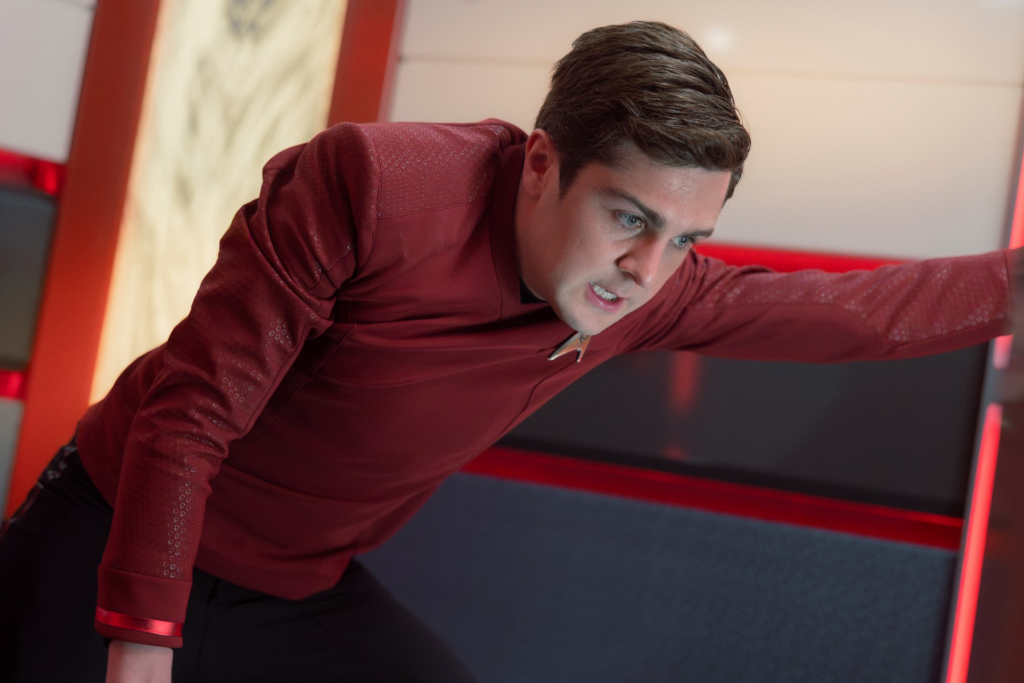
Once normal lighting disappears and emergency illumination takes over, the Enterprise stops looking like the beautiful flagship we normally admire and starts feeling like a metal pressure vessel full of failing systems. Corridors darken, machinery strains, consoles spit sparks, and the ship seems to groan under forces it was never designed to withstand.
That physicality matters because modern Star Trek can occasionally make danger feel strangely clean. Huge things happen outside windows while everybody remains standing beneath immaculate lighting. Here, equipment moves, people get hurt, the ship shakes, and the environment itself becomes threatening. For much of the episode, the Enterprise is effectively the monster.

The sound design works in much the same way. The ticking running beneath parts of the score could have become unbearably obvious, especially when the episode already has a visible countdown, but mostly it works as an underlying pulse. You start to feel time passing rather than simply watching a number decrease in the corner of the screen.

At other times, I could almost feel the episode elbowing me in the ribs.
Yes. I’ve seen 24.
There are moments when the technique becomes more noticeable than whatever is happening inside the frames, and that is where “Off-Hour” comes closest to the same problem that has affected several episodes this season: Strange New Worlds being slightly too pleased with the fact that it has discovered another way to tell a story.
The crucial difference this week is that the story would still work without it.
Take away the countdown graphics and the split screens, and you still have a strong episode about a crippled Enterprise, a fragmented crew, and people making increasingly difficult decisions under pressure. The formal experiment enhances something that already has a solid dramatic foundation rather than becoming the foundation itself.
Coming immediately after “Level-Five Transporter Accident” inevitably makes “Off-Hour” feel even better, although I don’t want to give it extra points simply because the previous episode set the bar somewhere around deck plating.
The contrast does expose just how wildly uneven this season has become.
One week we have Spock kissing T’Pring while puppets fight pirates. Seven days later, the show gives us people being crushed, improvised emergency medicine, failing engines, and a crew desperately trying to prevent their ship being torn apart. Somehow, both of those things belong to the same television series.

That range is part of Strange New Worlds’ identity, and I don’t want the show to become afraid of experimenting. Star Trek should occasionally be weird. It has been weird since 1966. What “Off-Hour” demonstrates is the difference between experimentation that serves the story and novelty that becomes the story.
The real-time format imposes discipline. Dialogue has to move somewhere. Characters have to act rather than endlessly discuss what they might do. Scenes have to hand momentum to one another, and the constraint forces the episode to concentrate on decisions, consequences, and people doing their jobs while everything around them falls apart.
Strip away some of the excess, and what remains is remarkably sturdy: a damaged ship, an impossible problem, and a group of people who know what they’re doing trying to fix it before the clock runs out.
“Off-Hour” is probably my favourite episode of Strange New Worlds Season 4 so far. It isn’t perfect, and occasionally its stylistic influences become a little too visible, but it delivers tension, character, physical stakes, and the sort of procedural problem-solving that Star Trek has always done particularly well.

Most importantly, it doesn’t prove that Strange New Worlds should stop experimenting.
It proves that the experiment has to serve the story.
8.5/10