
Star Trek: TOS — “Shore Leave” (S01E15) Review
A man thinks about a tiger, and a tiger appears.
That might be the simplest expression of what “Shore Leave” is doing. The Enterprise arrives at what appears to be an empty, idyllic planet, its crew exhausted after months of continuous operations, only to discover that thought itself has somehow become dangerous. Memories, fantasies, fears, and half-formed daydreams are given physical form almost immediately, whether the person thinking them genuinely wants that to happen or not.

It’s a brilliant science-fiction idea wrapped inside one of the silliest episodes of Star Trek’s first season, and somehow, for a surprising amount of its running time, it works.
The opening tells us exactly why the Enterprise needs this place before we know anything about what the planet actually is. Kirk is tired, irritable, and resistant to admitting either, so Spock approaches the problem in the most Spock way imaginable. He describes an unnamed crewmember whose performance has deteriorated badly enough that Kirk immediately orders him to take shore leave.
The crewmember, of course, is James Kirk.
“Enjoy yourself, Captain.”

It’s a lovely little scene because it doesn’t turn Kirk’s exhaustion into some enormous crisis of command. He’s simply knackered. He has spent months being responsible for hundreds of people, making decisions where mistakes can mean death, and, like plenty of people who are very good at telling everybody else to look after themselves, he doesn’t recognise when the same advice applies to him.
That gives “Shore Leave” more substance than its giant rabbit, samurai warrior, medieval knight, tiger, Second World War aircraft, and theatrical costume rack initially suggest. Beneath all the nonsense is a story about people who desperately need permission to stop being responsible for a while.
Kirk needs it more than most.
His encounters with Finnegan are probably the best expression of that because there’s nothing especially profound about Kirk’s resentment of the older Academy cadet who apparently made his life miserable. Finnegan isn’t Khan. He isn’t Kodos. There’s no great moral wound waiting to be uncovered.

Kirk just really wants to punch him.
That pettiness is precisely why it works. Kirk has grown into a starship captain, crossed the galaxy, faced death repeatedly, and become responsible for the lives of an entire crew, yet somewhere underneath all of that is still the young Academy student who would dearly love five minutes alone with the smug bastard who used to torment him.
So the planet gives him five minutes.
Quite a lot of five minutes, actually.

The fight eventually goes on far too long, but William Shatner’s physical performance sells the basic idea wonderfully. Kirk stops behaving like Captain James T. Kirk of the USS Enterprise and becomes Jimmy again, chasing Finnegan through the rocks, getting knocked down, scrambling back up, and eventually beating the living daylights out of him with an enormous grin on his face.
For once, there’s no diplomatic consequence, no ship to save, and no civilisation hanging in the balance. He gets to win a stupid fight he’s probably been replaying in his head for years.

That is shore leave.
The same idea appears in Ruth, although in a completely different emotional register. Kirk remembers a woman he knew fifteen years earlier and suddenly she’s standing in front of him exactly as he remembers her. Gerald Fried’s score does an extraordinary amount of work here, separating the melancholy surrounding Ruth from the deliberately irritating playfulness accompanying Finnegan. “Shore Leave” was Fried’s first Star Trek score, and already you can hear how much personality he could give a scene through music rather than dialogue.
One memory needs punching. Another needs holding onto.

That mixture of emotional nostalgia and complete absurdity is where “Shore Leave” is at its best. McCoy wandering after Alice and a giant White Rabbit should be ridiculous because it absolutely is, but DeForest Kelley treats the whole thing with enough sincerity that the joke never collapses into parody. His developing flirtation with Yeoman Tonia Barrows gives the episode some warmth as well. Kelley is something of a secret weapon here, capable of making even the broadest material feel as though it’s happening to an actual person rather than somebody waiting for the next gag to arrive.
Unfortunately, Barrows also exposes where the episode’s playful attitude gets itself into trouble.

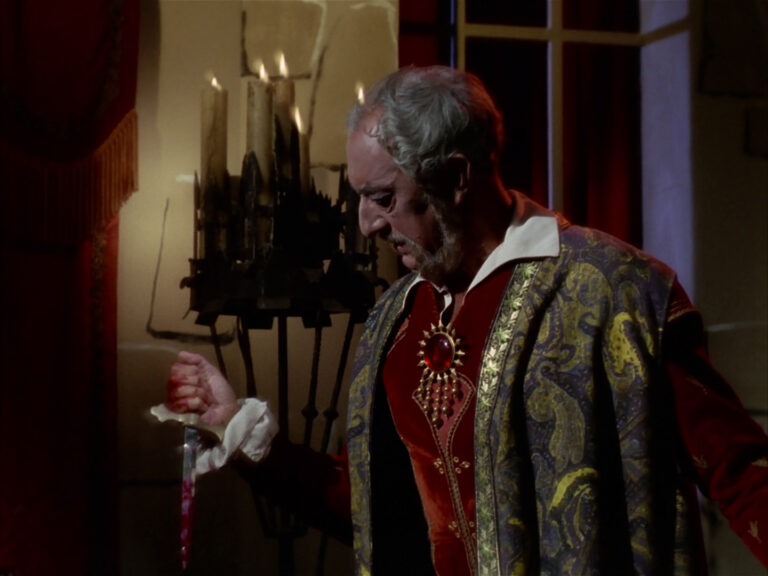
After thinking about Don Juan, she finds herself confronted and attacked by a physical manifestation of him. I can recognise that this is television made in 1966 without pretending that makes what happens disappear, and I don’t think there’s anything inherently unbelievable or objectionable about a woman fantasising about some romanticised Don Juan figure. Of course some women would.
The problem is what the episode does with the fantasy.
A private daydream isn’t consent to having somebody physically force himself on you, yet “Shore Leave” largely absorbs Barrows’ experience into the same whimsical procession as the rabbit, Alice, and princess dress. Something from inside her head has been turned into a threatening physical encounter without her permission, which is rather darker than the programme seems willing to acknowledge.

You don’t need to put the entire episode on trial over it, but nearly sixty years later it sticks out.
That tonal problem becomes even bigger when McCoy is run through by a medieval knight.
It’s an effective moment precisely because the episode suddenly stops feeling safe. The knight isn’t pantomime danger. McCoy goes down, apparently dead, and Kirk and the others genuinely believe they’ve lost him. Elsewhere, members of the landing party are strafed by an aircraft, while communications and transport become unreliable as the Enterprise struggles to understand what is happening beneath the surface.

The trouble is that “Shore Leave” wants those moments to carry genuine peril and then, eventually, asks us to treat them as part of the fun.
It doesn’t always manage the transition.
There’s also a point where the Enterprise crew become frustratingly slow on the uptake. Someone thinks about something, and it appears. Someone else remembers something, and that appears. It happens again and again, long after the audience has worked out the basic relationship between thought and manifestation, while Kirk and his officers continue treating each occurrence as though it might be entirely unrelated to the last one.

These are people who can usually extract a life-or-death conclusion from three sensor readings and one raised Spock eyebrow.
Eventually, even they get there.
Spock realises that the planet is capable of manufacturing the objects and people entering the crew’s thoughts, and Kirk’s immediate solution is essentially to order everybody to stop thinking. That may be the least achievable command he gives during the entire five-year mission.

The explanation finally arrives with the Caretaker, who reveals that the planet is effectively an alien amusement park. Its machinery reads visitors’ thoughts and creates experiences for them. Nothing is intended to be permanent, and even McCoy is restored alive and apparently unharmed.
It’s a wonderfully audacious concept for 1966. Watching it now, it’s difficult not to see something resembling an early ancestor of the problem Star Trek would eventually encounter with recreational technologies such as the holodeck. There’s no reason to claim a direct production lineage between the two, but the same fundamental question is sitting there decades earlier: what happens when imagination can become physically real?

More interestingly, what happens when the system decides what you want before you’ve consciously asked for it?
This is supposedly an amusement park, yet nobody bothers to tell the Enterprise crew that before the machinery begins rummaging around inside their heads. There’s no introduction, no warning, no explanation of the rules, and definitely no consent screen.
Think about your childhood bully, and here he comes.
Remember an old love, and she’s waiting for you.
Imagine Don Juan, and hope for the best.
Think about a tiger, and you’ve got a tiger.

For all the episode’s silliness, there’s something genuinely unsettling in that idea. Human beings are full of intrusive thoughts, fears, memories, fantasies, grudges, and mental rubbish that doesn’t necessarily represent anything we actually want. A machine capable of turning all of that immediately into physical reality would be less an amusement park than an occupational health incident waiting to happen.
Which makes Kirk’s final decision rather astonishing.
Having just watched members of his crew attacked by a knight, a tiger, an aircraft, and assorted manifestations of their own subconscious, having believed one of his closest friends was dead, and having temporarily struggled to maintain reliable contact between the Enterprise and the surface, Kirk decides this sounds absolutely ideal for several days of crew leave.
Apparently the Caretaker promising that everything will be all right is sufficient risk assessment for Starfleet.
Still, I understand why Kirk stays.

“The more complex the mind, the greater the need for the simplicity of play” is the episode’s real thesis, and there’s something in it. Kirk needs Finnegan. McCoy needs romance and absurdity. Others find themselves confronted by memories, fantasies, and simpler versions of themselves. Even when the execution becomes messy, “Shore Leave” understands that rest isn’t the opposite of responsibility. Sometimes it’s what allows you to continue carrying it.
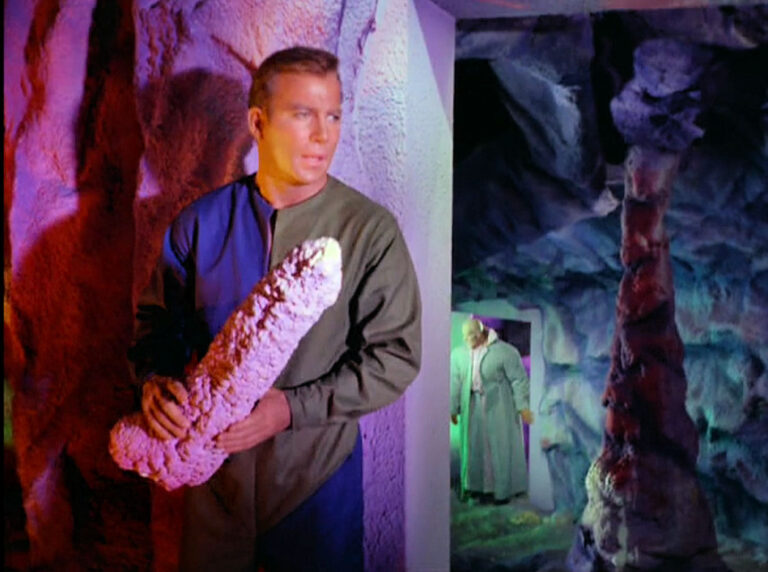
Artistically, the episode benefits enormously from escaping the soundstage. The extensive location photography at Africa U.S.A. and Vasquez Rocks gives “Shore Leave” a completely different texture from many of the more studio-bound episodes around it, with open skies, greenery, dusty rocks, and real sunlight making the planet feel expansive in a way painted backdrops rarely can. The production then throws Starfleet uniforms, medieval armour, Alice in Wonderland characters, twentieth-century aircraft, and brightly coloured costumes into that landscape, creating exactly the kind of visual collision the premise needs.
You can see the seams in places, of course. Trees and rocks have been painted to make the landscape seem more alien, and some of the fantasy elements have the unmistakable theatrical quality of 1960s television rather than anything approaching realism.

I kind of love it, as a lifelong fan of Doctor Who having started watching when I was a child and collecting the DVD’s it’s what I am used to in my classic Sci-Fi.
The whole episode has an earnestness to it. Nobody behaves as though they’re above the material, and that makes an enormous difference. A giant White Rabbit can run past McCoy without the programme stopping to reassure us that everybody involved knows how ridiculous this is. Finnegan can appear from nowhere laughing like a malicious Jack-in-the-box. A medieval knight can thunder through the landscape immediately after something that feels like children’s fantasy.
Sometimes the shifts are too abrupt, but they’re memorable.
The rather chaotic production history probably explains some of that unevenness. Theodore Sturgeon supplied the original story and teleplay, Gene Coon substantially revised it, and Gene Roddenberry carried out further extensive rewriting as production closed in, with changes famously continuing during the location shoot. The episode ran to seven shooting days rather than the usual six.
You can almost feel those different versions wrestling with each other on screen.

There’s Sturgeon’s strong science-fiction idea about fantasy and the psychological need for play. There’s the broad comic adventure full of rabbits, knights, aircraft, and old girlfriends. Then there are flashes of something much darker about memories becoming physical without permission, people being injured or apparently killed, and a machine capable of reaching into the unconscious before its users even know it exists.
The finished episode never entirely reconciles them.
That’s why the middle drags. Once we understand what the planet is doing, “Shore Leave” becomes a parade of variations on the same trick while we wait for the characters to catch up and the Caretaker to arrive with the instruction manual. Kirk’s fight with Finnegan is fun but overstays its welcome, the danger occasionally becomes too real for the breezy resolution waiting at the end, and the explanation amounts to the Caretaker turning up and telling everyone that they’ve misunderstood the ride.
Yet I still enjoy it.
Coming immediately after “Balance of Terror” in the original broadcast sequence, there’s something refreshing about watching Star Trek discover that it can loosen its collar. “Balance of Terror” is tense, controlled, and deadly serious; “Shore Leave” lets Shatner run around punching an old school bully while McCoy chases a rabbit. That range would become one of the franchise’s great strengths, even if early Star Trek hadn’t quite learned how to move between those tones cleanly yet.
Shatner gets to be funny and physical, Kelley gets some wonderfully warm material, Spock quietly demonstrates that he understands his captain rather better than Kirk understands himself, and Gerald Fried gives the episode an identity almost as strong as anything in the script. Visually, it’s bright, strange, and unmistakably first-season Star Trek.

There’s a genuinely clever idea underneath it all too: people who spend their lives exploring the unknown finally finding somewhere designed purely for play, only to discover that they’ve become so accustomed to danger that they don’t know what play looks like anymore.
“Shore Leave” doesn’t always know either.
It’s too long in the middle, far too casual about some of the darker implications of its own premise, and frequently asks us to forget that experiences still hurt simply because somebody can repair the damage afterwards. But there’s a warmth to it that carries an awful lot, especially whenever it stops worrying about explaining the planet and simply lets these characters be people rather than officers.
For Kirk, that means getting muddy, bruised, exhausted, and finally beating the tar out of Finnegan.
Perhaps Spock knew exactly what he was doing when he ordered him to take a holiday.
7.5/10