Star Trek

  • |

    Star Trek: TOS – The Corbomite Maneuver (S01E10)

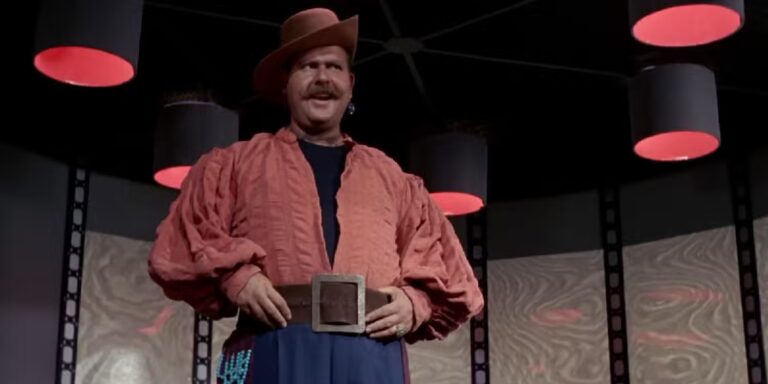
    There’s a small moment early on that tells you more about this episode than the plot ever does. Spock looks at Balok’s face on the viewscreen, a snarling oversized puppet built to terrify, and instead of flinching he says one word: fascinating. Leonard Nimoy was still refining Spock at this point, and director Joseph Sargent reportedly told him to be different, be the scientist, be detached. That single word is where the Spock we all recognise really starts to emerge. It’s a quiet decision, and it tells you everything about what this episode is doing underneath the space bluff and the countdown clock.

  • |

    The Constitution-Class: The Ship That Bet Everything on Exploration

    Show someone who has never seen a minute of Star Trek a picture of the original Enterprise, and they will still know what they are looking at. A ship. Something built to go a long way from home. The wide saucer, the slim neck slung beneath it, the two engines held out on struts well clear of the body. That outline has been printed on lunchboxes, flown on parade floats, and rebooted on cinema screens for the better part of sixty years, and it is still the first thing a great many people picture when someone says the words science fiction.

  • |

    The Klingons: A Code, or a Costume? (Race Spotlight)

    A man stands in the Great Hall on Qo’noS, accused of a treason his father never committed, and the most powerful Klingon in the room knows he is innocent.

    Chancellor K’mpec has the truth in front of him. The defence codes that allowed the Romulans to destroy Khitomer, four thousand dead in a single night, were not transmitted by Worf’s father Mogh. They were sent by Ja’rod, father of Duras, whose house carries too much weight on the Council to be touched without splitting the Empire. So the Council does the arithmetic and lets an innocent name carry the guilt. K’mpec asks Worf to swallow it, to accept discommendation and a lifetime of public shame, so that the Empire does not crack along the fault line the truth would open. And Worf does. He turns, and a hall full of warriors crosses their wrists and turns their backs on him, one by one, for a crime that did not happen.

    That is the most honour-obsessed culture in Star Trek, transacting in a lie, in the one building where honour is supposed to mean something. Remember that image. Everything else here pulls against it.

  • |

    Spock: A Bridge Between Two Worlds (Character Spotlight)

    A bridge belongs to neither shore. Its purpose is to connect two places without ever becoming either of them. No character in Star Trek embodies that better than Spock.

    Look at the moment in “Amok Time” when he turns and sees Kirk alive. Seconds earlier he believed he had killed his captain with his own hands, in ritual combat, on the soil of his homeworld. Then Kirk walks back into the room, and the most disciplined officer in Starfleet breaks into a grin and shouts his name before he can stop himself. “Jim!” Then comes the recovery, the face reassembling itself. The grin is the man. The recovery is the officer he has trained himself to be.

  • |

    Star Trek: TOS – Dagger of the Mind (S01E09)

    A plastic dome hangs from the ceiling of a treatment room, a small light turning inside it. That is the entire neural neutraliser, the device the whole episode is built around, and on paper it is nothing. A prop the art department could have thrown together in an afternoon. By the closing minutes it is one of the most frightening objects the original series ever put on screen, and the distance between the first impression and the last is most of what makes “Dagger of the Mind” worth talking about.

  • |

    What Makes Star Trek, Star Trek?

    Try a thought experiment in two directions. Take everything people point at when they call something Star Trek: the Enterprise, the uniforms, the phasers, the Vulcans, even the Federation itself. Strip all of it out. Could a story still feel unmistakably like Trek with none of that in frame? Now run it the other way. Keep every ship, every delta, every familiar alien, and remove only the ideas underneath them. Would that still be Trek, or just cosplay with a budget? Hold both questions at once, because the gap between them is where the answer lives.

  • |

    Star Trek: TOS — Miri (S1E08)

    The children are heard before they’re seen. Voices carry down an empty street, a playground chant bounces off buildings nobody has lived in for centuries, laughter arrives with nothing funny behind it. Spock describes them scurrying away “like animals,” and for a stretch in the middle of it, “Miri” is one of the genuinely unsettling things Star Trek made in the 1960s. Long before zombies became a genre anyone could phone in, TOS built a dead suburb full of feral children and trusted the silence to do most of the work.

  • |

    The Art of Star Trek & Defiant — The Bright and The Stolen Ships

    Flip from the Star Trek half of this book to the Defiant half and you can feel the temperature drop. One minute you are looking at Ramón Rosanas’s clean, sunlit bridges, the kind of art that makes the 24th century look like somewhere you would actually want to live. The next you are in Ángel Unzueta’s painted murk, where a crew of rogues aboard a stolen ship glower out of the shadows like they have somewhere worse to be. The Art of Star Trek & Defiant collects two years of comics that ran side by side, and the cleverest thing about it is that it never once pretends they were the same show.

  • |

    The Gorn: People or Monster’s? (Race Spotlight)

    Kirk has the thing beaten. He has spent the back half of “Arena” turning a barren rock and a handful of raw minerals into a working cannon, sulphur and charcoal and a few rough diamonds packed into a length of bamboo, and now the Gorn captain is down in front of him, wounded and waiting for the killing blow. The Metrons have all but invited it. And Kirk lowers the weapon.

  • Star Trek: The Mirror War — Emperor Riker and the Long Road to Earning It

    The premise of The Mirror War has almost everything going for it on paper. The TNG crew, transplanted to the Mirror Universe. Captain Picard not as the man who reads archaeology and quotes Plutarch, but as an Imperial officer building an armada to drag the Terran Empire back from the edge of extinction. It should be irresistible. The question, after sitting with this collected edition for a while, is whether the execution lives up to what the concept promises. The answer is mostly yes. The caveats are where things get interesting.