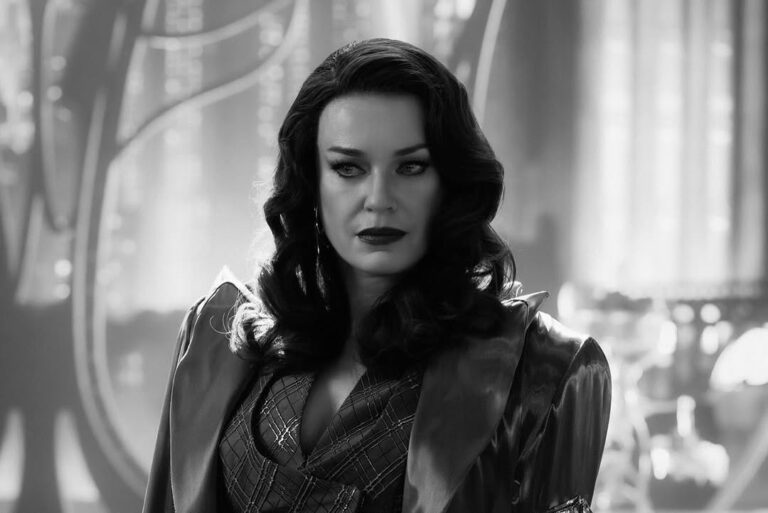
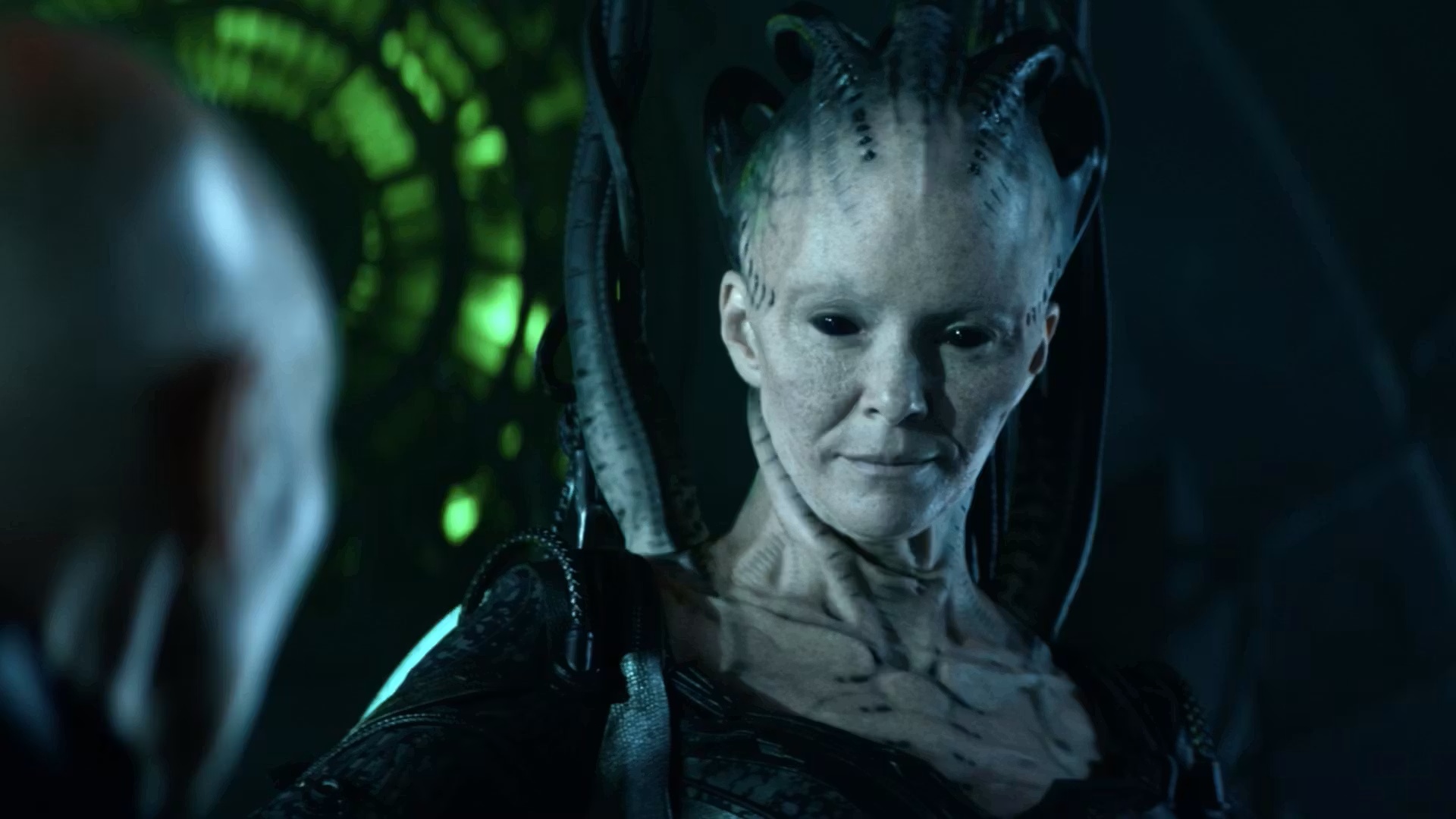
The Borg Queen: Did She Save the Borg, or Ruin Them? (Character Spotlight)
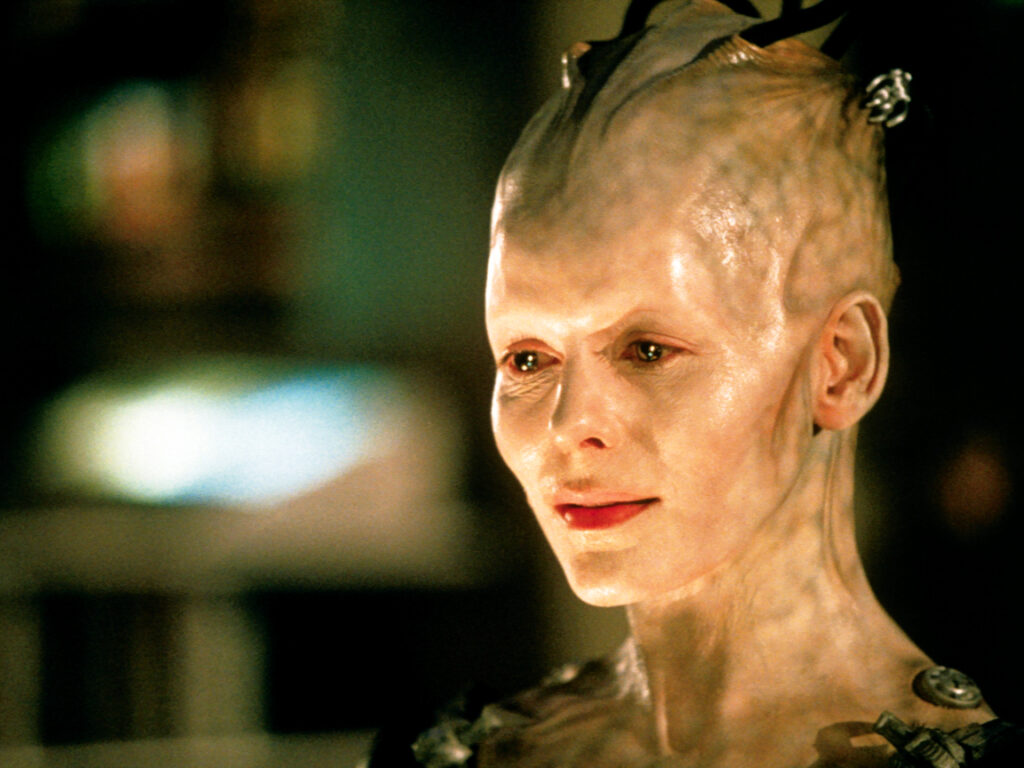
A disembodied head descends from the ceiling on a mechanical spine, lowers itself onto a waiting body, and Alice Krige looks up at Patrick Stewart with a smile that is simultaneously welcoming and predatory. “I am the Borg,” she says. From that moment on, nothing about the Borg is quite what it was.
That is precisely the problem, depending on who you ask.
The Borg Queen is the most argued-over character Star Trek has ever produced. Not because she’s a poor villain, she isn’t, but because her existence raises a question the franchise has been circling without resolution for nearly thirty years: what happens to a concept built on facelessness when you give it a face? The debate has never really changed. She either saved the Borg as a storytelling proposition or dismantled what made them uniquely terrifying. There is evidence for both. That’s why people are still arguing about it nearly thirty years later.
Production Genesis
The Borg Queen wasn’t in the first couple of drafts of First Contact. She emerged from a structural problem.
The original Borg, the ones who terrified audiences across “Q Who” and “The Best of Both Worlds,” were a force of nature rather than a character. They didn’t negotiate. They didn’t explain themselves. They engaged with no one in any way that resembled a conversation. On television, across two or three episodes, that indifference was the horror. A two-hour Hollywood feature film operates differently.
Brannon Braga was candid about it. The Borg weren’t interesting enough for a feature film because they didn’t say anything. They were, as he put it, robot zombies. Paramount’s then-chairman Jonathan Dolgen pushed the writers for a stronger villain. What First Contact needed was someone who could occupy scenes with Picard, someone who could look at Data and identify something worth corrupting, someone capable of carrying a confrontation rather than simply advancing as an unstoppable wave. The Queen solved all three at once. She gave the Borg a mouth, and through that mouth, an agenda.
Ronald D. Moore understood both what the decision gained and what it gave away. The Queen worked brilliantly in the film. Moore later acknowledged that her invention conceptually altered the Borg in ways he hadn’t fully anticipated. When you solve a screenwriting bottleneck by introducing a monarch, you don’t just address the dialogue problem. You redefine what the Collective actually is.
There’s a wider context worth noting. The writers weren’t only solving a dialogue problem. First Contact was being structured as a more traditional Hollywood adventure film, and the influence of productions like Alien is visible throughout its development. Blockbusters of that era expected a central antagonist the audience could identify and track. The Queen fills that function as much as any purely internal creative necessity. Understanding that doesn’t diminish her, but it does explain why the solution took the specific shape it did.
Who Is She
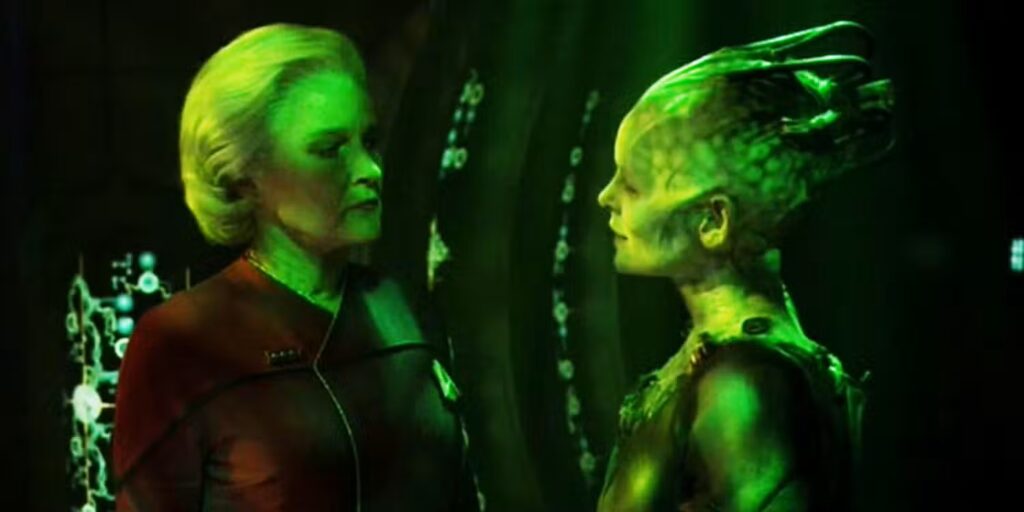
Since First Contact, the Queen has become one of Star Trek’s most frequently recurring villains. Voyager embraced her most enthusiastically, building multiple stories around her relationship with Seven of Nine. Lower Decks brought Krige back for a brief holodeck appearance, while Picard explored both Jurati’s alternative Collective and the dying remnants of the original Borg.
In-universe, the Queen describes herself as “the beginning, the end, the one who is many.” She coordinates the hive mind in a way the pre-1996 Borg never suggested they needed. Various licensed novels and reference works have offered possible origins for the Queen, though no definitive on-screen explanation has ever been provided. What the franchise consistently establishes is that the Queen is not quite what she claims to be. She says she is the Collective. She behaves as though she rules it.
The Shift from Force to Seduction
That gap is the most interesting thing about her, thematically.
The Borg of “The Best of Both Worlds” carry their horror precisely because nothing personal is happening. There is no hatred in what they do to Picard, no desire for revenge, no special cruelty reserved for a Starfleet captain. They process him as they process everything. He is relevant only as a communication interface, and even that is disposable. The existential weight of those episodes comes from the Borg’s total indifference, the sense that humanity doesn’t register as meaningful in any way the Collective would acknowledge.
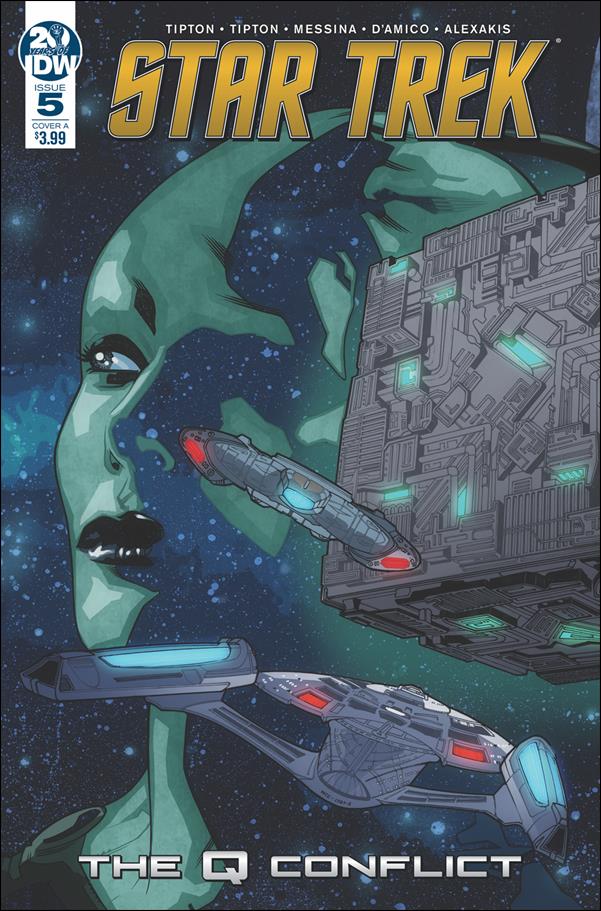
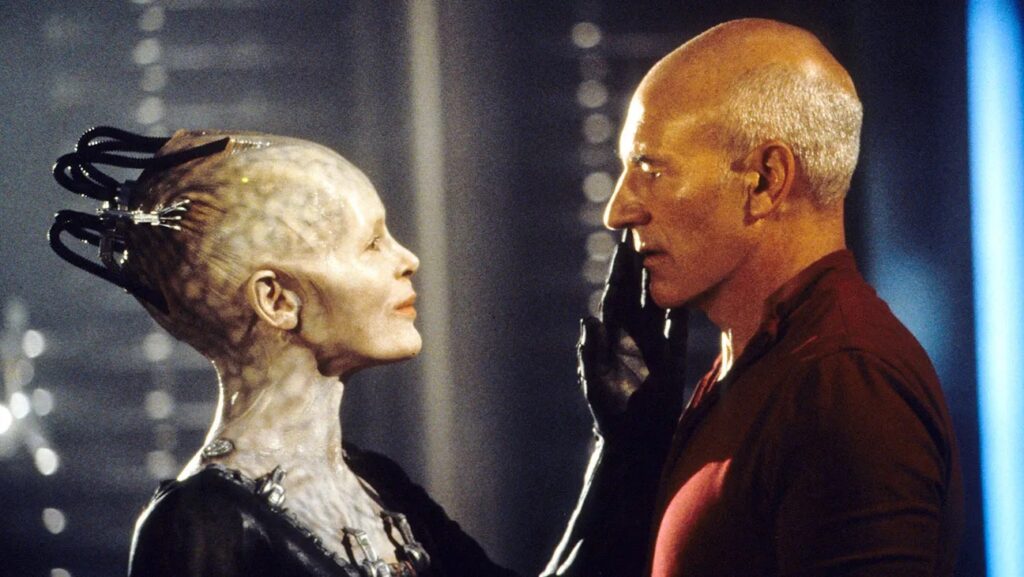
The Queen turns that inside out. Her Borg seduces rather than assimilates. She identifies what each person most wants and constructs a version of it. With Data, she finds his desire to feel, to be human, and builds him a patch of skin and blows on it while he tries not to reveal how much it affects him. With Picard, she exploits the unresolved trauma of Locutus, treating him not as a recovered casualty but as an estranged equal, a king she never quite stopped expecting to return. Her methods are intimate in a way the original Borg never were.
That contradiction sits at the centre of the character. The Borg’s stated ideology is the elimination of the individual in favour of the collective. The Queen is, definitionally, the exception. She retains desire, preference, obsession, and vanity. She uses the word “I” without hesitation. She has grudges. She is visibly hurt when Data betrays her. A being who genuinely embodied the Borg ideal couldn’t experience any of those things.
The Queen is individuality dressed in collectivist clothing.
The Borg are supposed to eliminate the self.
The Queen is the self.
The Actresses and Their Monarchies
Three actresses carried the role across its most significant appearances, and each played a meaningfully different version of the character.
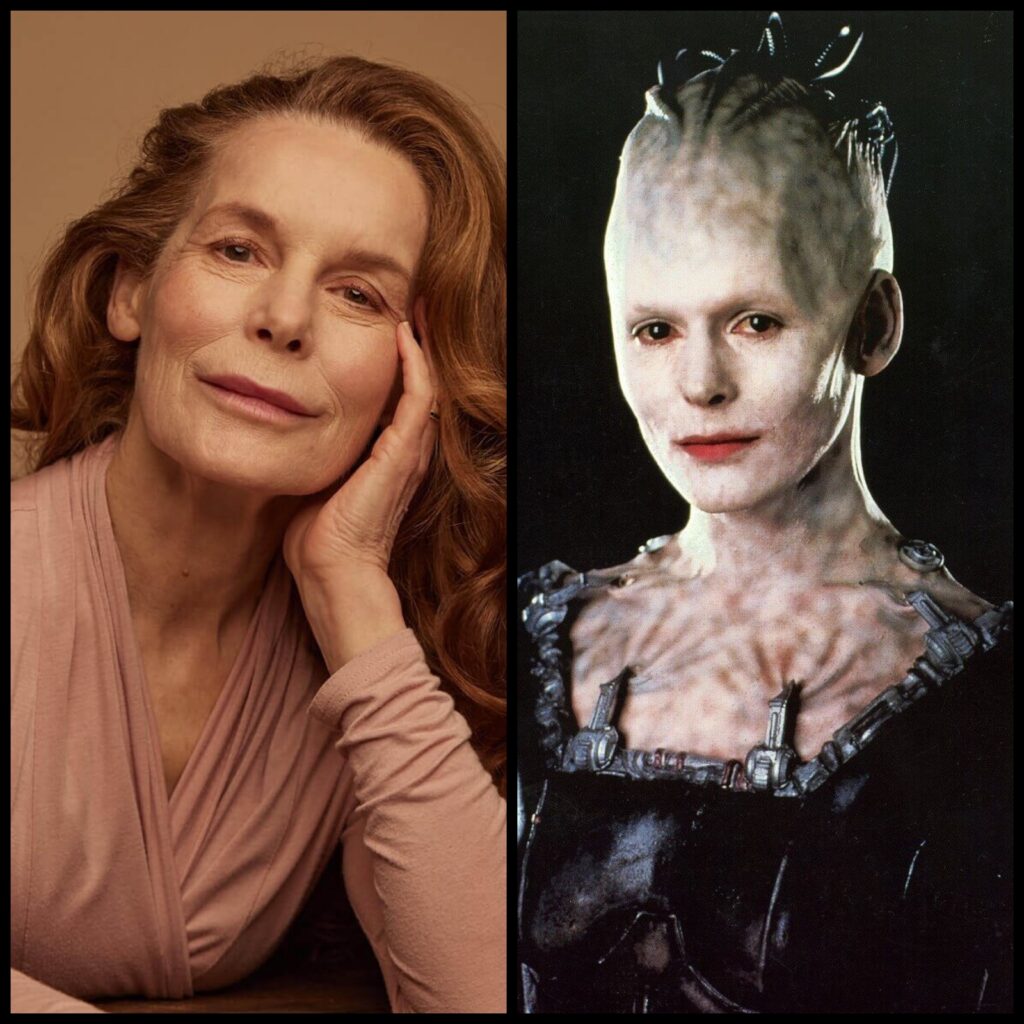
Alice Krige originated it in First Contact and returned for “Endgame.” Her Queen feels ancient. There is something in Krige’s performance that suggests a being who has been waiting longer than most civilisations have been existing, patient in the way only something genuinely indestructible can afford to be. She almost never raises her voice. The scene in which she applies the skin graft to Data is played as seduction so complete it barely registers as threat, two beings negotiating something that neither of them has words for. Krige’s conceptual foundation for the character was that the Queen is pure, indestructible energy, manifesting whenever she chooses to, which gives the performance a philosophical strangeness that holds across rewatches.
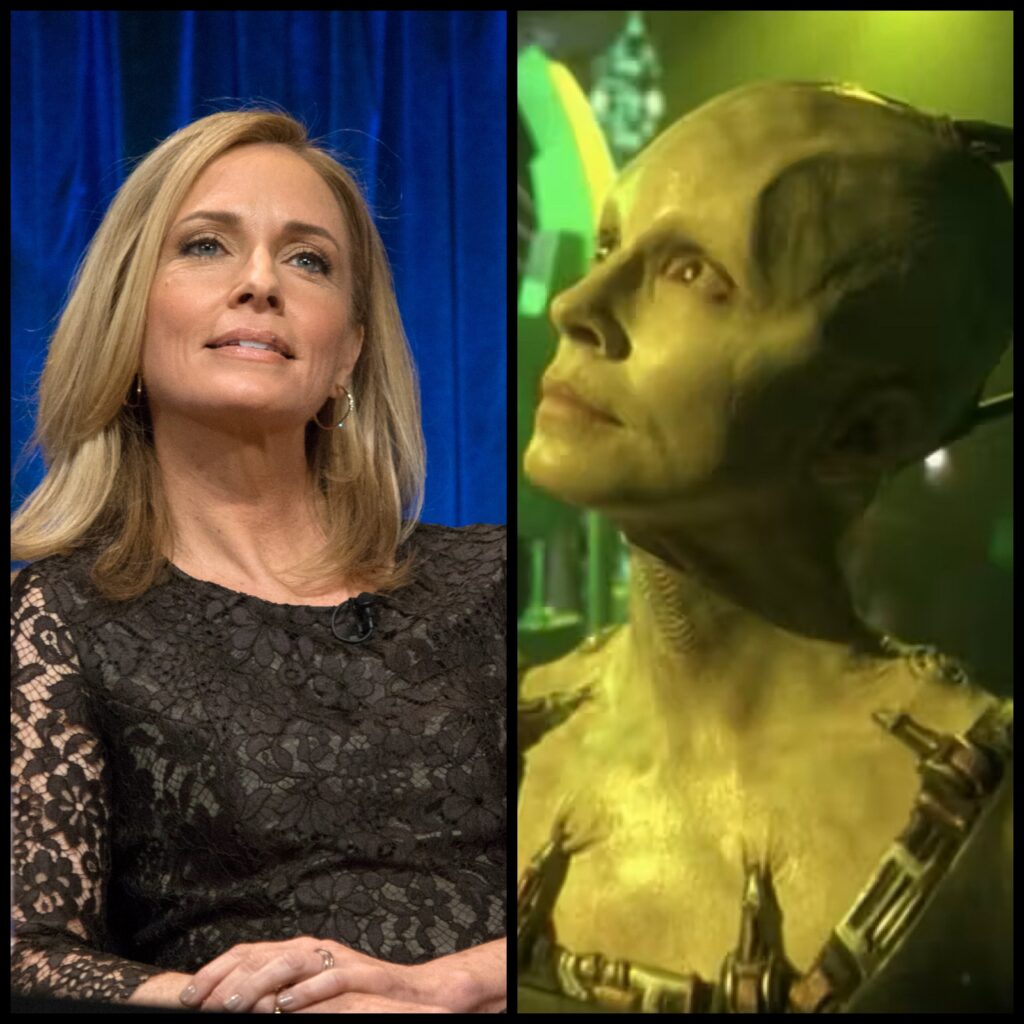
Susanna Thompson took the role in “Dark Frontier” and “Unimatrix Zero” when scheduling prevented Krige from returning. Thompson plays a harder, more openly aggressive version. Where Krige is patient, Thompson’s Queen is strategically vindictive, a commanding presence managing a crisis and cataloguing every slight. Brannon Braga noted she brought more of a maternal quality than First Contact had shown, and you see it clearest in “Dark Frontier,” where the dynamic with Seven of Nine stops being purely threatening and starts resembling a parent who cannot accept that the child left of her own free will.
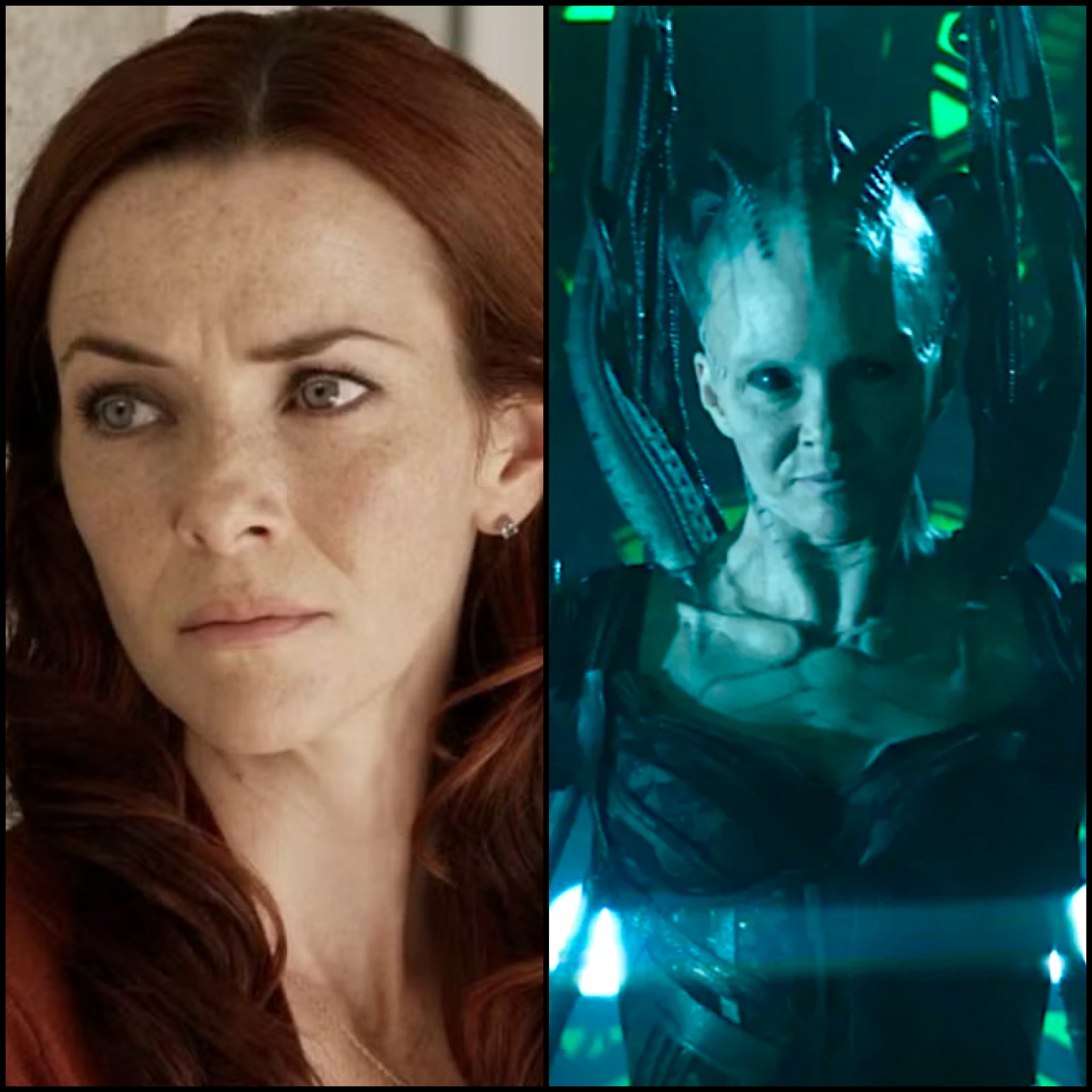
Annie Wersching in Picard season 2 inherited a character who had been stripped of almost everything: isolated, imprisoned, driven to the edge of coherence. Wersching plays feral rather than regal, a Queen surviving entirely on psychological manipulation because that is all she has left. The eventual merger with Agnes Jurati, which Alison Pill then carries through the season’s conclusion, is the most emotionally unexpected thing the Borg have done since the character’s creation, and it works largely because Wersching laid groundwork for a Queen desperate enough to consider compromise. She described Alice Krige as “the queen of all Queens,” which is both appropriate and a little generous to herself.
Psychological Architecture
Her key relationships form a pattern once you set them side by side. The Queen is consistently drawn to individuals who represent something she cannot fully possess.
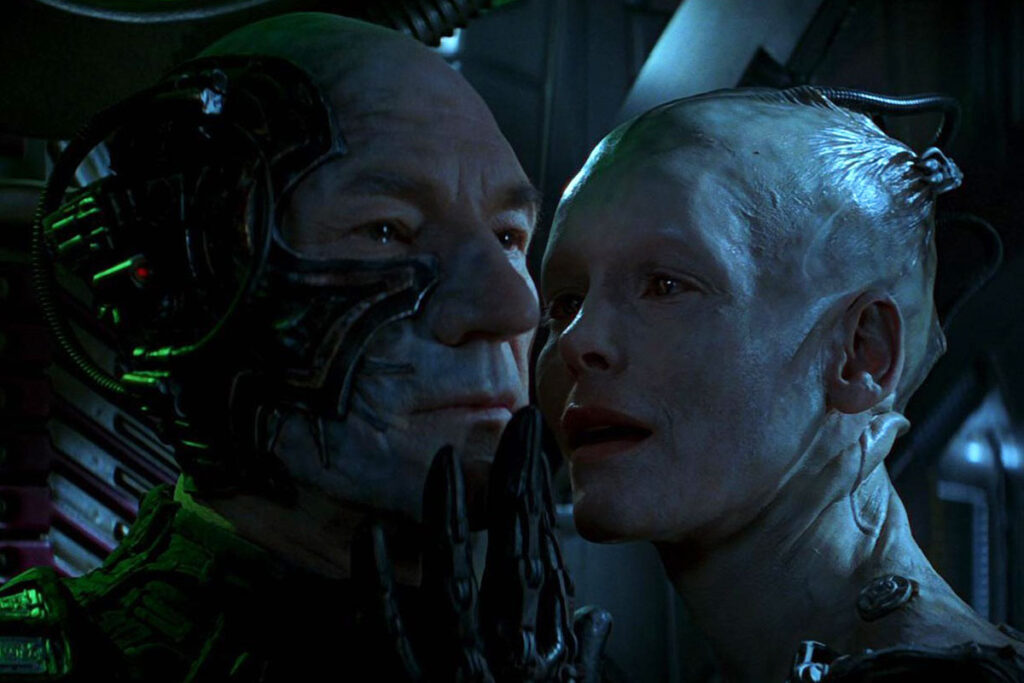
The Locutus fixation remains her most revealing dynamic. If every drone is equal, there is no logical reason for Picard to hold any special position in the Queen’s attention. But he isn’t special to the Collective. He’s special to her. She treats him as a counterpart, something the hive mind as originally conceived would have no use for. Her bitterness at his recovery reads less like strategic frustration and more like personal rejection, which is either the character’s most interesting quality or its most damaging one, depending on your tolerance for the Borg having complicated feelings about specific Starfleet captains.
The Data dynamic is arguably the emotional centre of First Contact. The Queen doesn’t attempt to assimilate Data in the conventional sense. She attempts to give him what he already wants and see what he does with it. Brent Spiner understood it clearly: her fascination with Data was rooted partly in the fact that he’d put the Borg to sleep in “The Best of Both Worlds, Part II,” and that history shaped his reading of their every exchange. For zero-point-eight-six seconds, as Data later tells Picard, he was genuinely tempted. That figure is the detail that haunts the scene long after the coolant has done its work.
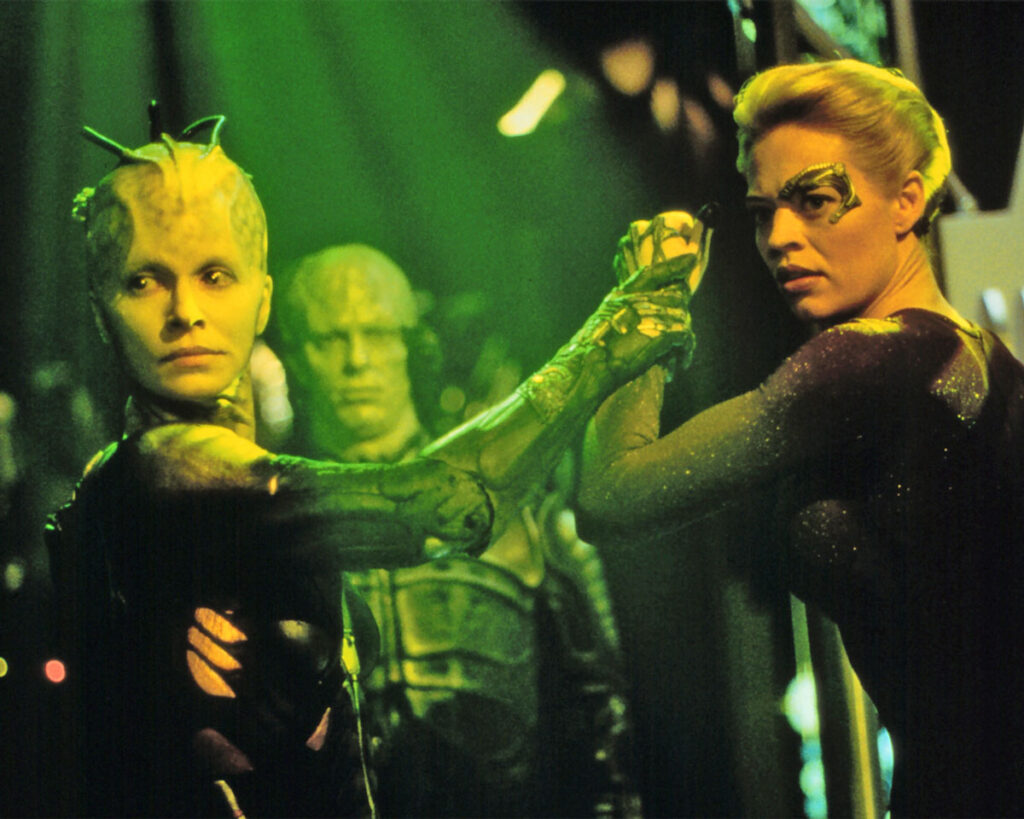
Seven of Nine is the relationship Voyager returns to most productively. The Queen treats Seven as a prodigal child whose departure she has catalogued as a wound. She cycles between affection, manipulation, and the kind of quiet threat that doesn’t need stating directly. The dynamic is recognisably abusive in ways the show mostly leaves implicit rather than naming. It works because it places the Queen in a relationship she cannot fully control, and the strain of that is visible every time Seven declines to come home.
The continuity around the character is, charitably, a creative decision, and less charitably, a loose end the franchise has been tidying since 1999.
The Queen dies in First Contact, returns in Voyager, dies again in “Endgame,” and reappears in Picard season 3 as though “Endgame” was more of a setback than an ending. The internal logic has never completely settled. Ronald D. Moore always maintained there was one Queen, death being a technicality the Collective’s resources could address. Brannon Braga and Thompson speculated that the Borg operate from a genetic template, regenerating a new Queen from stored biological material whenever the current one is destroyed. Wersching concluded her iteration was a different being carrying inherited memories. Krige’s framework, that the Queen is indestructible energy choosing a physical form, sidesteps the problem entirely and remains the most elegant solution anyone has proposed, whether the scripts consistently support it or not.
Picard season 3 added a final, striking complication: the original Queen had survived Voyager‘s neurolytic pathogen in a dramatically diminished state, cannibalising her remaining drones to sustain herself across years of isolation. This image, the most powerful force in the Delta Quadrant reduced to a starving remnant, is the most haunting thing the later-era Borg stories produced. It’s also the hardest to reconcile with her earlier presentations, one of those retroactive additions that enriches the mythology while making it considerably harder to map.
Did She Save the Borg, or Ruin Them?
The debate that started in 1996 doesn’t produce a clean verdict after thirty years. It produces an honest description of what the Queen cost and what she delivered.

She made the Borg narratively viable for a form they were not built for. She enabled decades of Voyager storytelling that would have been impossible with a faceless hive mind as the recurring antagonist. She produced some of the franchise’s finest villain work, and Krige’s performance in First Contact alone justifies the character’s existence regardless of what it cost the Collective conceptually. The Queen gave the Borg a drama they couldn’t have sustained without her.
She also turned the franchise’s most philosophically rigorous villains into something that runs on personal obsession, accumulated grievances, and a very recognisable loneliness. The original Borg didn’t need things. The Queen does, and need is an inherent weakness, which is why the Borg at their most frightening are always the ones operating in the episodes before she enters the room.
Both are true simultaneously. The Queen saved the Borg from narrative irrelevance and cost them their most distinctive quality in the same movement.
The original Borg were frightening because nobody was in charge.
The Borg Queen is fascinating because somebody is.