The Ferengi Were Never the Joke: Greed Is Eternal
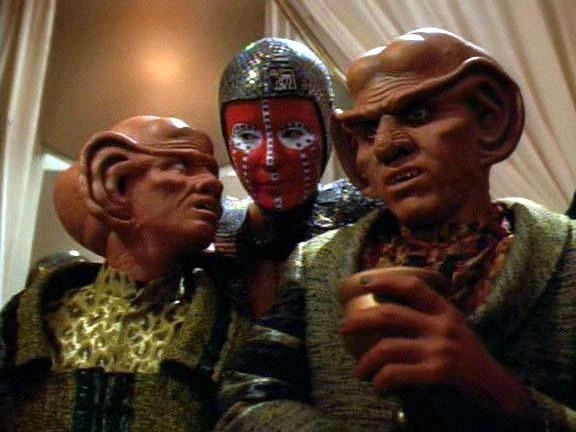
The joke of the Ferengi was never that they were aliens. The joke was that they weren’t. Strip away the oversized ears and the obsession with latinum and what you’re left with is a society built around competition, acquisition, branding, exploitation, and the belief that success excuses almost anything. The Ferengi were funny because they exaggerated attitudes that already existed in the real world. The uncomfortable part is how much less exaggerated they feel now than they did in 1987.
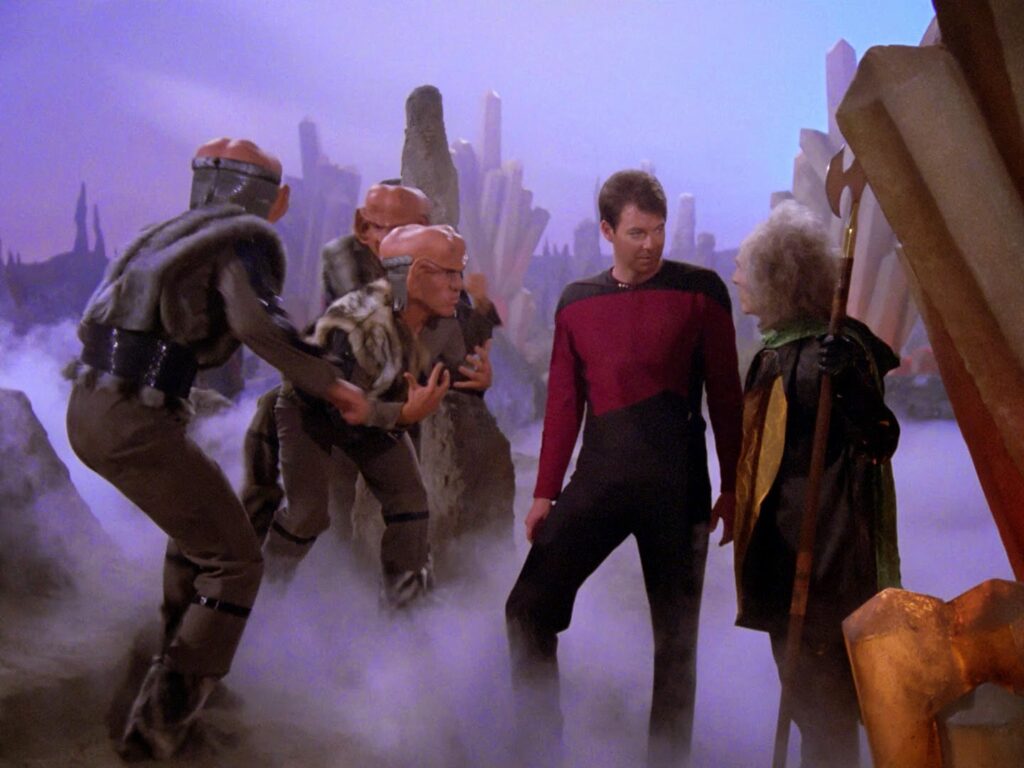
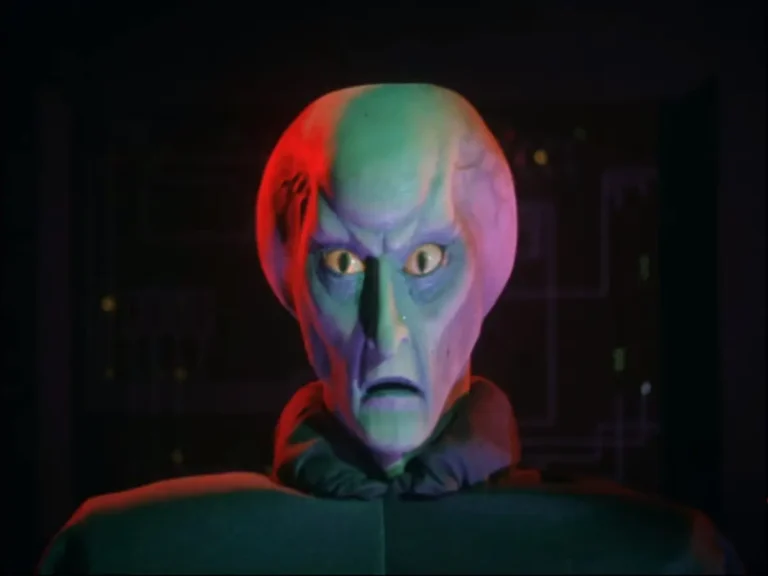
The original conception didn’t work. The Next Generation introduced the Ferengi as a major threat, a new adversary to fill the role the Klingons had vacated once the Federation shook hands and moved on. What arrived on screen instead were snivelling, leering, vaguely comedic figures who mostly got in the way of better episodes. The problem wasn’t the concept. It was that The Next Generation, in its optimism, didn’t quite know what to do with people defined entirely by profit motive. The Federation had largely evolved past money, at least internally, though Trek has never been entirely consistent about how its citizens interact with the wider galactic economy. The Ferengi had not evolved at all. That gap was played for laughs and not much else, because The Next Generation wasn’t really interested in interrogating what lay on the other side of it.
Deep Space Nine was interested. That’s the difference.
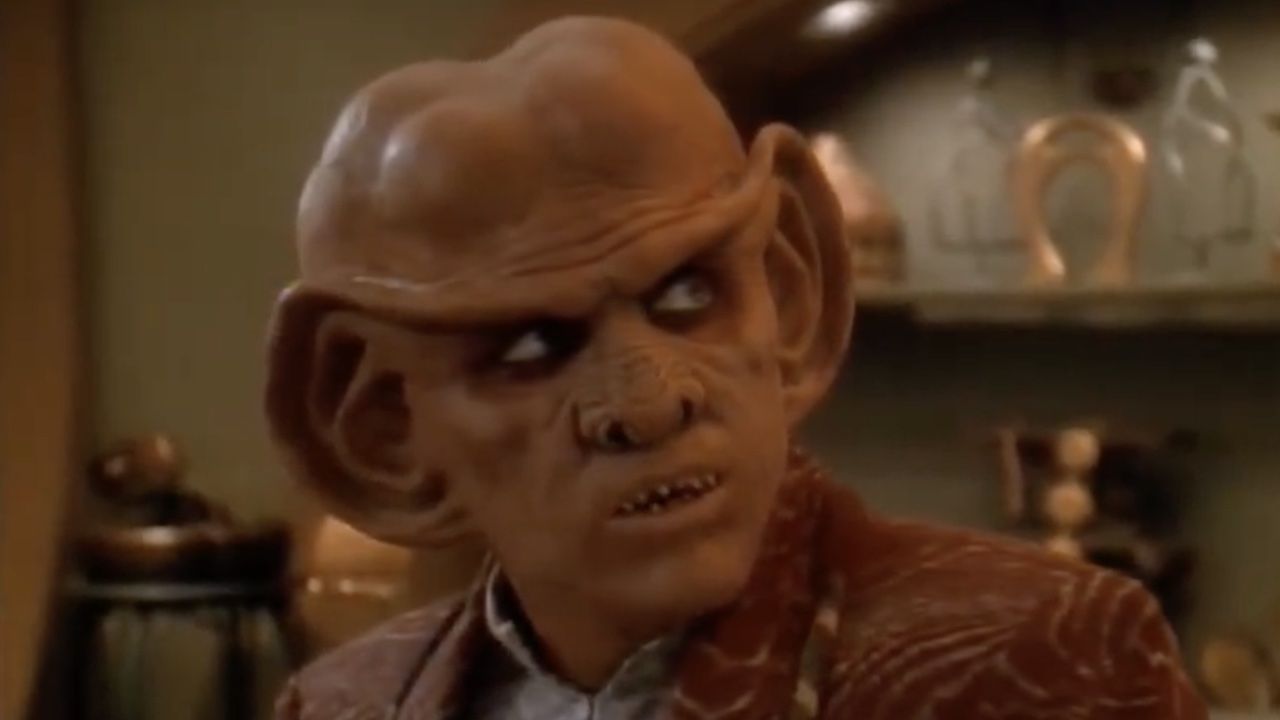
When the Ferengi arrived on the station, the show built an entire family around them: Quark, the bartender and semi-legitimate businessman whose fundamental decency kept undermining his business instincts; Rom, his brother, the supposedly dim one who turned out to be the most emotionally intelligent person in either family; and eventually Nog, Rom’s son, who became the first Ferengi in Starfleet. Add Grand Nagus Zek and his eventual reforms, and Deep Space Nine had constructed a four-generation study in what happens when a culture built on acquisition meets a value system that asks something different of people. It’s among the richest pieces of sustained alien world-building the franchise has ever produced, and most of it happened in B-plots.
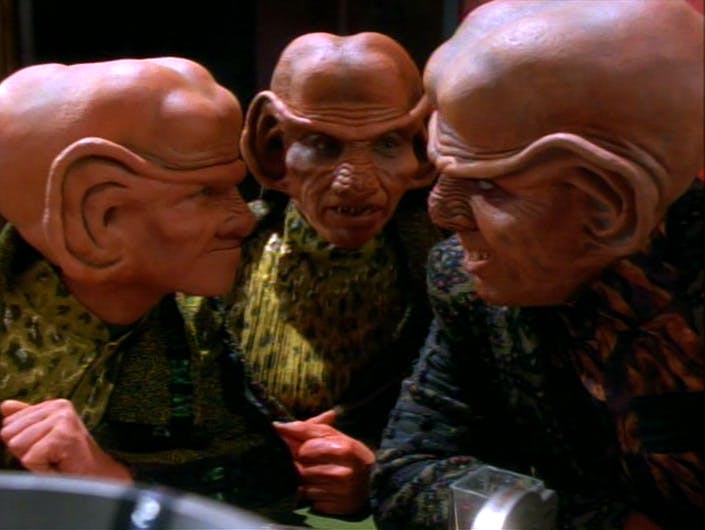
The book at the centre of all this, The Ferengi Rules of Acquisition, published in 1995 and written by Deep Space Nine showrunner Ira Steven Behr, collects seventy of the two hundred and eighty-five Rules. What makes the book fascinating is that it never breaks character. Behr writes the entire thing as Quark, complete with sales pitches, self-promotion, and increasingly desperate attempts to convince readers to buy extra copies for their friends. It’s not presented as a historical document or a guide to Ferengi culture. It’s presented as a Ferengi trying to sell you a Ferengi guidebook. The satire starts before you reach Rule One.
Reading it now, what strikes you isn’t the greed. It’s the rationalisation. Nearly every Rule exists not to celebrate acquisition but to justify it, to provide cover for behaviour that, without the cover, would be recognisable as straightforwardly cruel. “Never place friendship above profit” (Rule #21). “Trust is the biggest liability of all” (Rule #99). “Employees are the rungs on the ladder of success: don’t hesitate to step on them” (Rule #211). These aren’t the philosophies of a culture that loves money. They’re the philosophies of a culture that loves money and needs to believe it’s fine to love money. There’s a difference, and Deep Space Nine understood it.
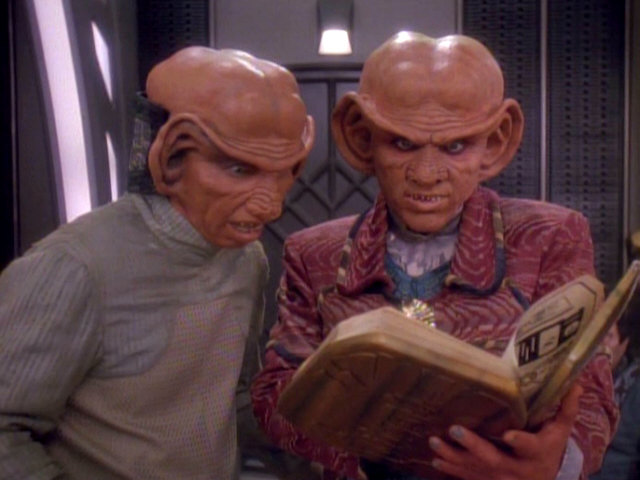
Rule #202 makes it explicit: “The justification for profit is profit.” The logic is entirely circular, which is the point. You don’t need a reason if you have a Rule. The Rules function as a moral system designed to pre-empt moral questions, a philosophical firewall between the Ferengi and any uncomfortable examination of what they’re actually doing to each other. Every human society has versions of this. The language changes but the structure is the same: the belief that the market is inherently just, that wealth signals virtue, that the successful deserve what they have and the unsuccessful deserve what they lack. The Ferengi just wrote it all down and gave it numbers.
What Deep Space Nine kept doing, quietly and without making a speech about it, was showing that the Rules don’t work. Not as satire from outside the culture, but from inside it, through the people most invested in believing them.
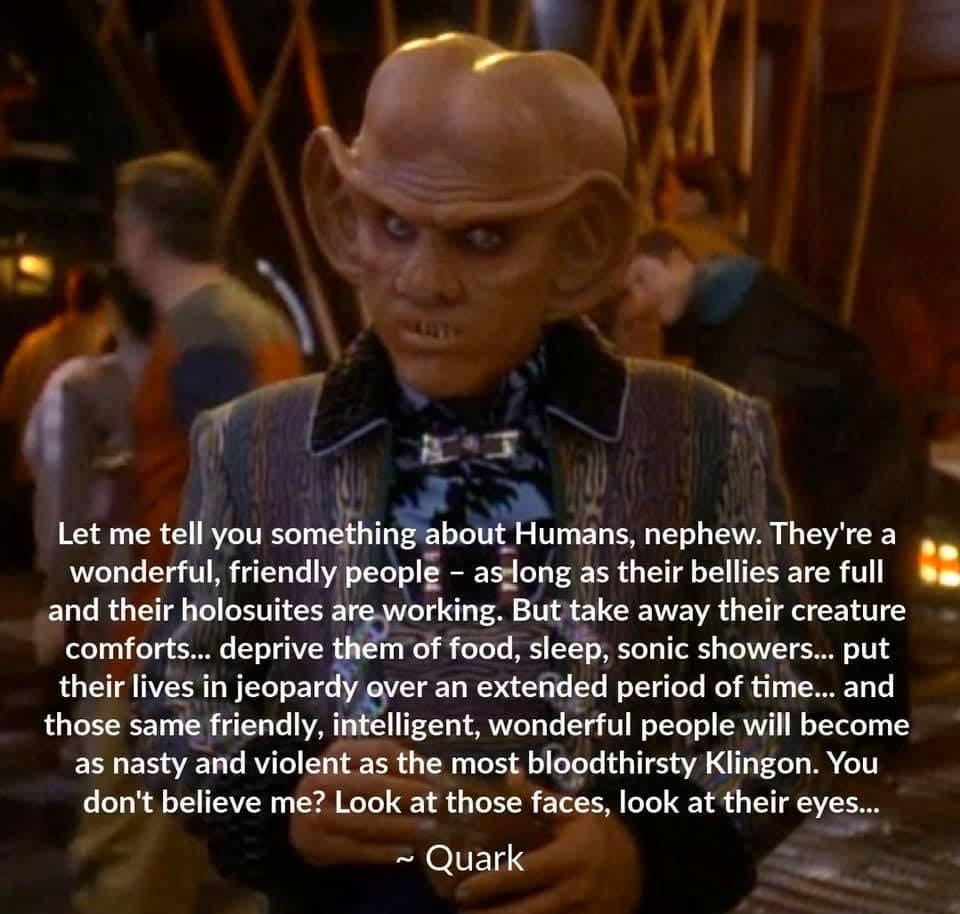
Quark is the most obvious case. He invokes the Rules constantly and violates them almost as often. He hides Bajoran refugees. He helps Kira on operations he has no business helping with. He risks his life, his bar, and his reputation for people who, by any Ferengi accounting, don’t represent a good return on investment. The show never lets him fully admit this about himself, which is what makes it work. Quark’s self-image depends on the Rules. The gap between who he says he is and who he actually is is where most of his best material lives.
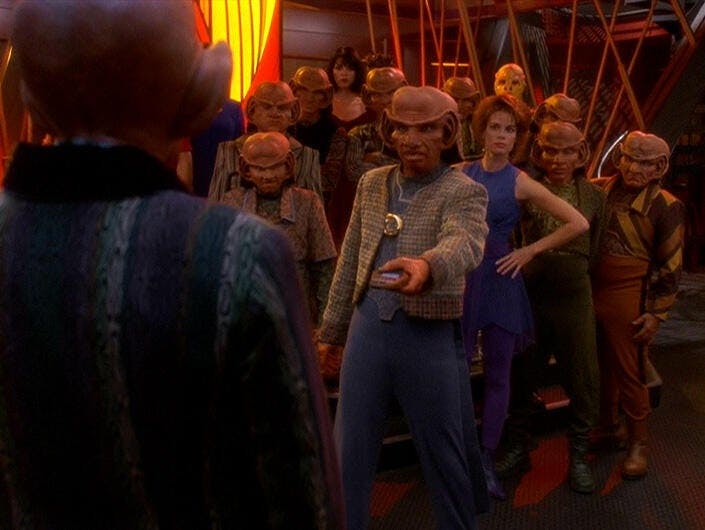
Rom is the more radical case. He’s the Ferengi the Rules failed most completely, written off as dim and useless because he couldn’t make a profit to save his life. What he had instead was genuine technical talent, genuine emotional depth, and a willingness to build a life around things other than latinum. He co-founds the first Ferengi labour union in “Bar Association,” which, by Ferengi standards, is roughly equivalent to storming the Winter Palace. The episode treats it as both comedy and something approaching heroism. Rom didn’t transcend the Rules by learning better ones. He just stopped pretending the Rules described anything real.
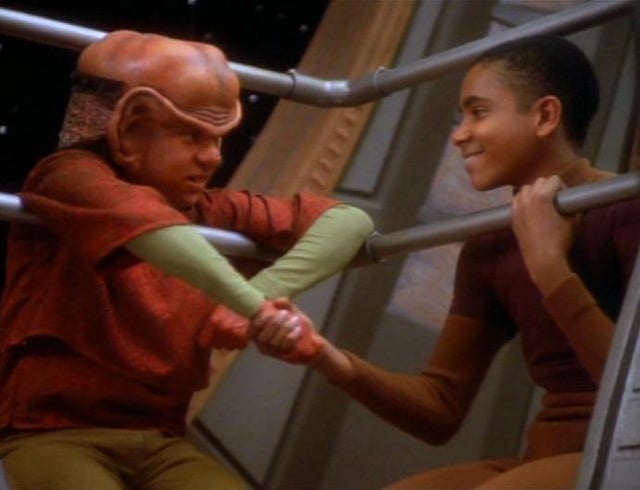
Nog’s arc is the franchise at its most quietly ambitious. He watches his father dismissed and diminished by a culture that measured worth in a currency Rom couldn’t accumulate, decides that isn’t the only available measurement, and joins Starfleet. What makes the arc land isn’t the joining, it’s what comes after. “It’s Only a Paper Moon,” in season seven, is a sustained portrait of trauma and recovery that has almost no precedent in Trek and precious little in television of that era. The Ferengi boy who wanted to be more than the Rules said he could be turns out to be one of the franchise’s most fully human portraits of what it costs to fight a war.
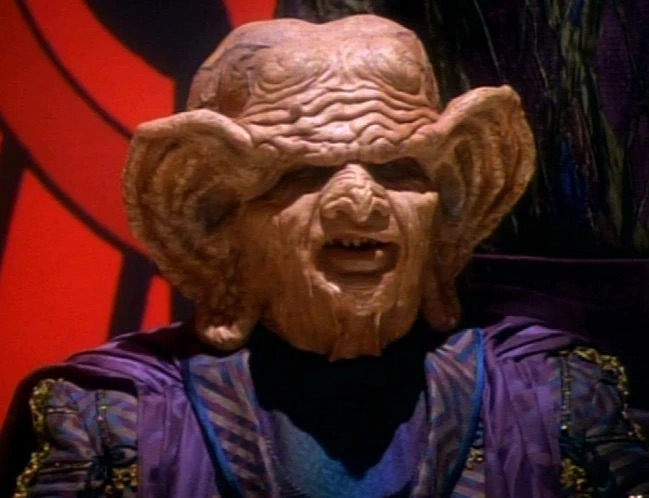
Zek’s reforms close the argument. By the end of Deep Space Nine, the Grand Nagus is moving Ferenginar toward something that looks, tentatively, like social progress: workers’ rights, female emancipation, and the naming of Rom, of all people, as his successor. The Federation’s response is notably measured. There’s no parade. No one from Starfleet Command rushes to congratulate the Ferengi on finally catching up. The show is sharp enough to notice that the Federation’s optimism about other cultures has limits, particularly when those cultures start making structural changes that raise uncomfortable questions about the gap between Federation ideals and Federation practice.
That irony is worth sitting with. The Ferengi are appalling because they say the quiet part loud. The Federation is comfortable because it wraps many of the same questions in nicer language.
Perhaps the most revealing Rule in the entire book is #284: “Deep down everyone’s a Ferengi.” It’s funny because it’s arrogant. It’s unsettling because the Ferengi spend seven seasons proving they might not be entirely wrong. Not that everyone wants profit above all else, but that every society develops stories that justify its own behaviour. The Ferengi wrote theirs down. Most cultures don’t.
The Rules of Acquisition were written in 1995, a specific cultural moment: post-Cold War triumphalism, the rise of globalisation, and the widespread belief that market forces were the closest thing to natural law a modern society could access. Behr wrote them as satire, and at the time they read as such. Three decades on, with a global economy that has spent most of that interval demonstrating how thoroughly the circular logic of Rule #202 can be internalised by real institutions, they read as something sharper. Not prophecy. Something more mundane and more disturbing than that.
The Ferengi were never the joke. They were always the mirror.